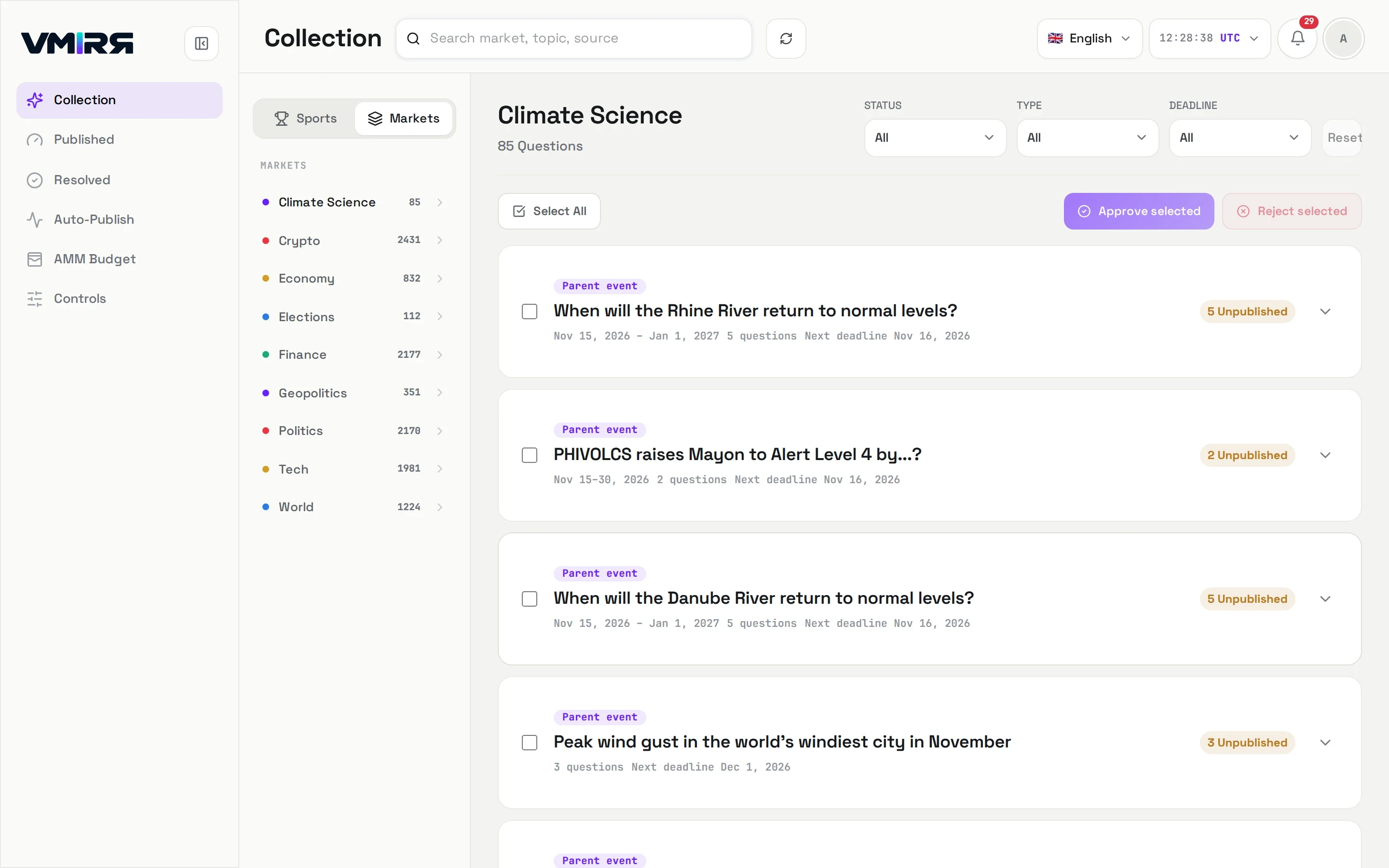
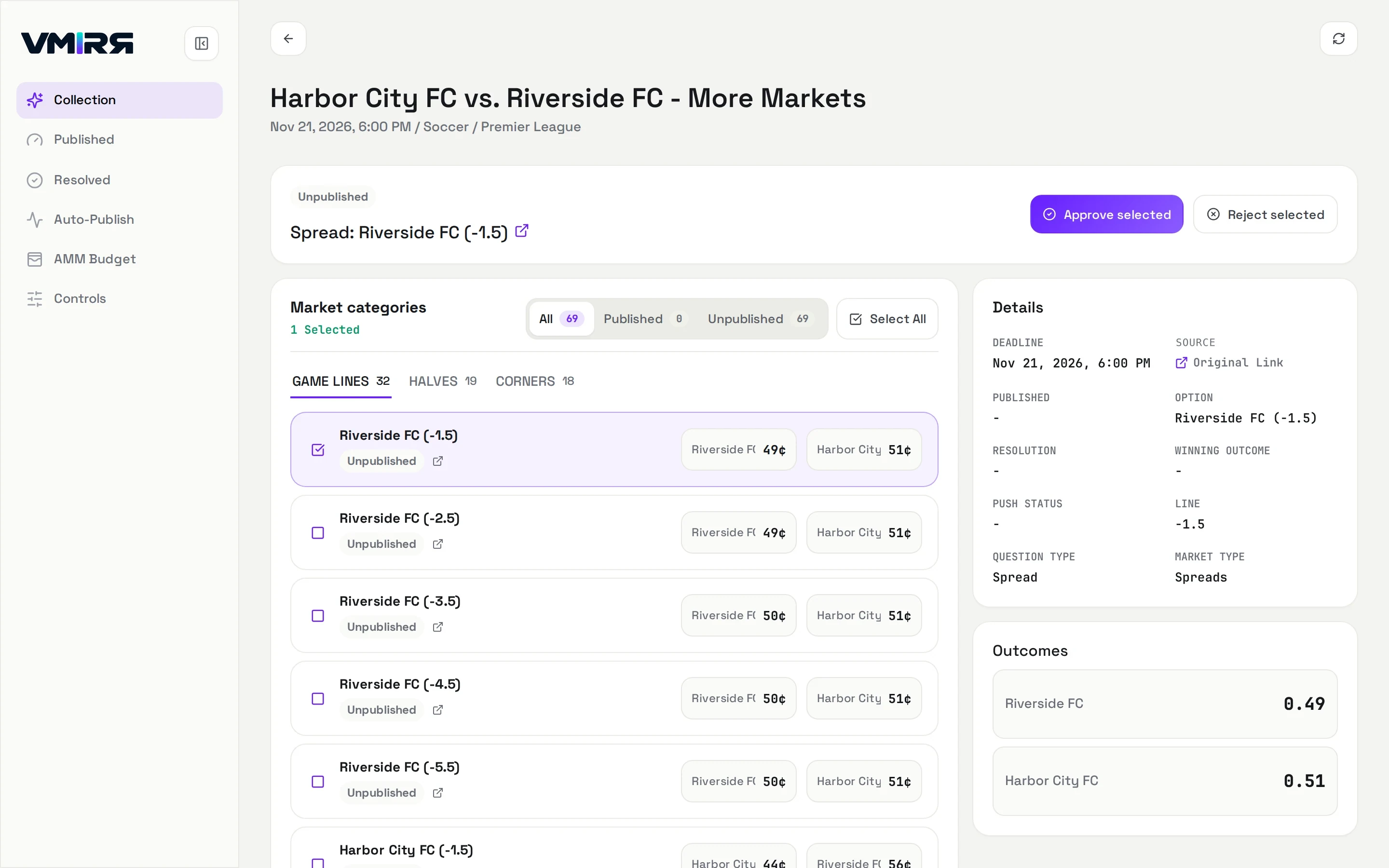
A full catalogue
Sports fixtures, props and world events, imported and sorted continuously.
VMIRR imports sports and world-event markets from an external exchange, applies your publishing rules and delivers them to your platform in your users' languages.
Approve by hand or by rule. Every market confirmed by your platform before it counts.
What VMIRR is
A syndication engine takes the markets an exchange already runs and republishes the ones you choose on your platform.
VMIRR imports sports and world-event markets, sorted by sport, league, match, question type or topic.
Your team approves what goes live, by hand or by rule. VMIRR translates and delivers them, keeping dates and results in sync.
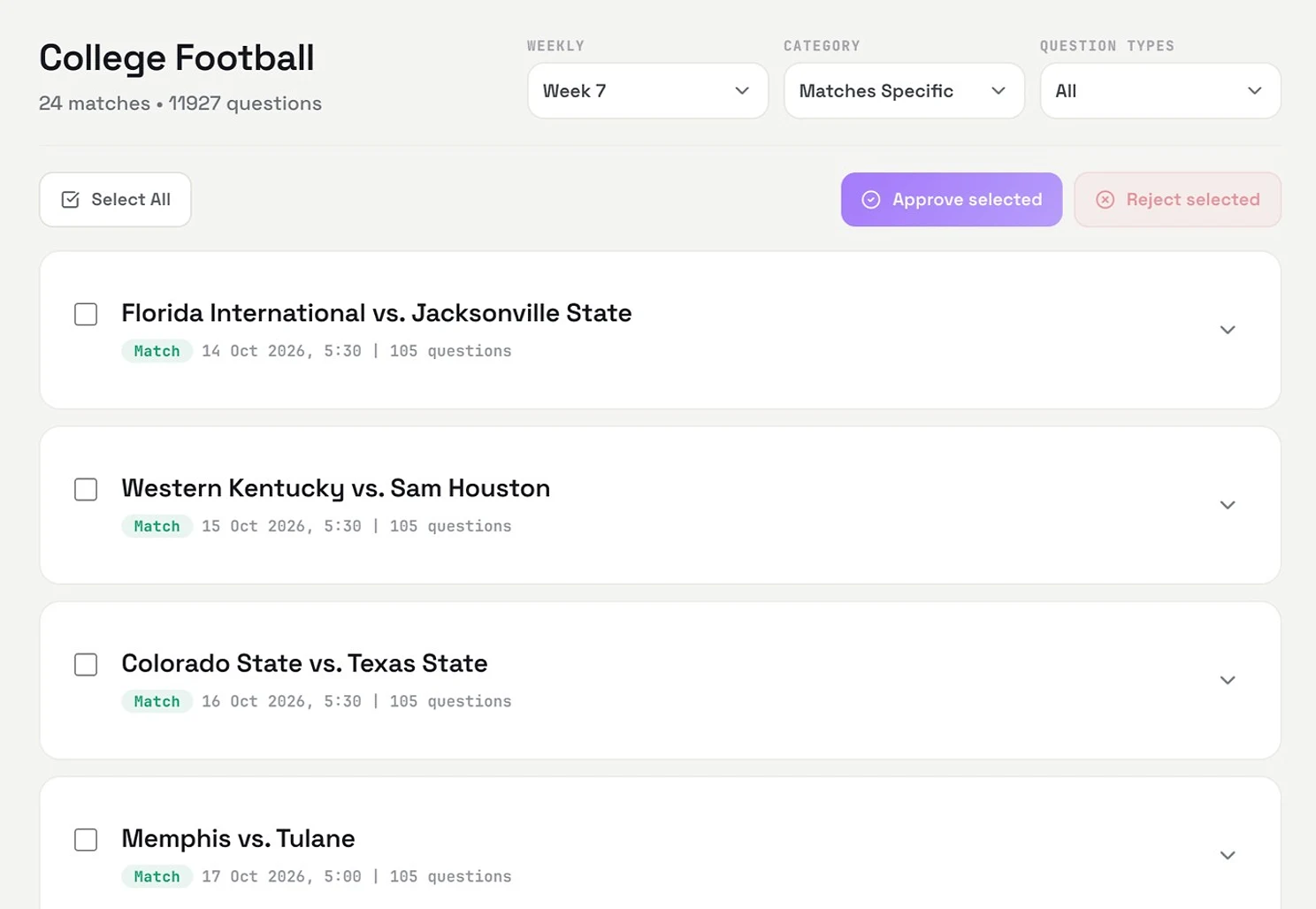
Sports fixtures, props and world events, imported and sorted continuously.
Approve by hand, or let Auto-Publish rules with quality gates do it.
Missing translations are filled for every language your platform enables.
A market counts as published only when your platform accepts it.
Demo snapshot, 12 Nov 2026. An example of source supply, not a guarantee.
Your desk reviews markets instead of writing them.
Talk to a specialist on our platform team and get answers right away
The catalogue problem
Visitors who find nothing to trade don't come back, and writing thousands of markets by hand is slow and error-prone.
An empty site wastes acquisition spend, and quiet categories lose users later.
Questions, outcomes, rules and dates take desk time, and typos cause disputes.
Postponed fixtures and final results need constant manual clean-up.
Translating every question and rule by hand doesn't scale.
How VMIRR works
Every market follows the same six steps, and everything flows one way: from the source, through VMIRR, to your platform.
Continuous scanLive new-market signal
25 sport familiesParent and child grouping
Manual approvalRule gatesDry run
TranslationsPrice scalingAMM budget
Confirmed acceptanceFull audit record
PostponementsResults pushedLive scores
Confirmed delivery
VMIRR reads your platform's response line by line. A market goes live in its records only after your platform accepts it with no error and no skip.
If your platform reports a missing sport, league or topic, VMIRR creates it and retries in the same run.
If the connection drops mid-send, the market is marked ambiguous. Retrying it needs an explicit confirmation.
Each delivery is stored with the exact request sent and your platform's response, with credentials removed.
Any question about what was sent is answered from the record.
Human control
Imported markets wait in the Collection until your team or a rule approves them.

Auto-Publish
Tell VMIRR which kinds of markets to publish automatically, with explicit quality gates. Try the default gates on a market of your own.
Default settings of a new rule. Every gate can be changed or switched off per league or category, and a per-match or per-event cap also applies. Volume and liquidity are the source exchange's figures, used only for gating.
Liquidity settings
For sports, set an AMM budget per league and question type.
League and question type must both be on, or 0 is sent.
Saved changes apply to newly published events.
World-event markets carry no budget today.
VMIRR passes the number on and holds no funds.
One-way relay
Everything moves one way: source, VMIRR, your platform. Nothing is sent back.
Your platform's schedule and results stay correct without manual clean-up.
Sportsbook-grade depth
Who it is for
Launch with a full catalogue on day one.
Markets organised like your book.
Fill quiet categories such as crypto.
Decide by rule what goes live.
One catalogue in many languages.
Inside VMIRR
Real VMIRR admin screens from the demo instance, with fictional club names.
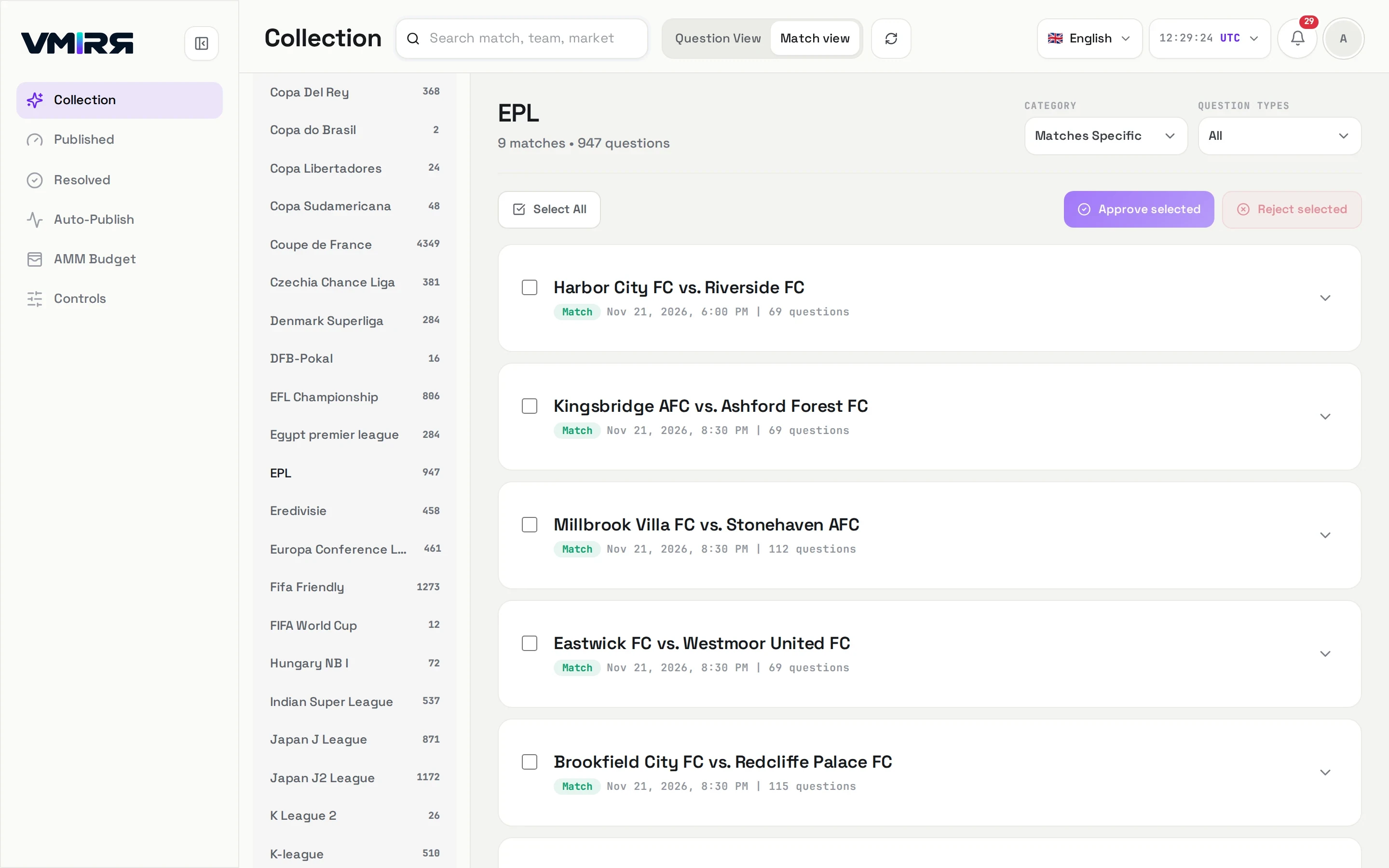
Sports Collection: browse imported fixtures by league and bulk-approve whole matches.
FAQ
VMIRR imports from an external prediction-market exchange, through its public market data and live feeds. It brings in sports fixtures and props as well as world-event markets such as politics, crypto, finance and economy, sorted by sport, league and category. Ask us about the sources your platform needs.
No. Imported markets wait in the Collection until someone approves them, or until an Auto-Publish rule you have switched on selects them. Rules start switched off. You can reject markets and hide whole sports, leagues or categories from your team's workspace.
You create a rule per sports league or market category and set gates such as minimum 24-hour volume, minimum time to resolution, a game window, confirmed teams only and a maximum number per match or event. Markets that pass every enabled gate publish automatically. A dry run shows what would publish before you switch the rule on.
Partly. Sports match markets use configurable title templates such as “Who will win the match?”, and VMIRR translates questions, outcomes and rules into your platform's languages. Editing the text of an individual market, or its resolution rules, isn't available. Rules stay as written at the source, so settlement matches the source's result.
VMIRR copies the current price when it publishes a market. After that, it sends postponements, new start times, cancellations and final results to your platform, and offers live scores and live probabilities for published sports markets over WebSocket. It doesn't relay order books, orders or trades, and never sends anything back to the source.
VMIRR follows the source exchange's result. When the source settles a market, VMIRR sends the winning outcome to your platform: per market for sports, and per complete event group for world-event markets. A cancelled match, or one settled 50-50, is sent as a cancellation. VMIRR doesn't decide outcomes itself.
For sports, you can switch on an AMM budget per league and question type. VMIRR attaches that whole-number budget to each new event it publishes, and your platform's AMM uses it. VMIRR holds no funds and takes no positions. Saved changes apply only to future events.
A market is marked Published only after your platform confirms it with no error and no skip. Every delivery attempt is stored with the exact request and your platform's response, with credentials removed. If a connection drops mid-send, the market is marked ambiguous and is never retried silently.
VMIRR reads the languages your platform enables and fills any missing translations for titles, questions, outcomes and rules. Seventeen locales are configured by default, including Spanish, Portuguese, Hindi, Japanese, Korean, Chinese, German, French and Russian. You can also send source text untranslated. The admin panel itself is available in six languages.
VMIRR recognises 25 sport families, including soccer, basketball, American football, tennis, cricket, hockey, baseball and esports. It maps markets into 25 categories such as Game Lines, Exact Score, Halves, Player Stats and Team Props. It handles binary, multi-option, range, prop and line markets, and groups them under a parent match.