Complete markets
Question, outcomes, rules, deadline, source, image and context, ready to list.
VMAQE drafts the question, outcomes, rules, source and image, then an independent AI reviewer scores every draft before your team sees it.
Yes/No and multi-option markets. Review queue or auto-publish. 47 languages.
What VMAQE is
An AI prediction market creator turns what is happening in the world into complete, listable markets, so no editor writes each one by hand.
With VMAQE you set an engine's topic, market types, deadlines, language, sources and schedule. Each cycle it searches the live web and drafts markets.
An independent AI reviewer scores every draft. Only markets that clear your quality bar reach the review queue, or publish on their own if you allow it.
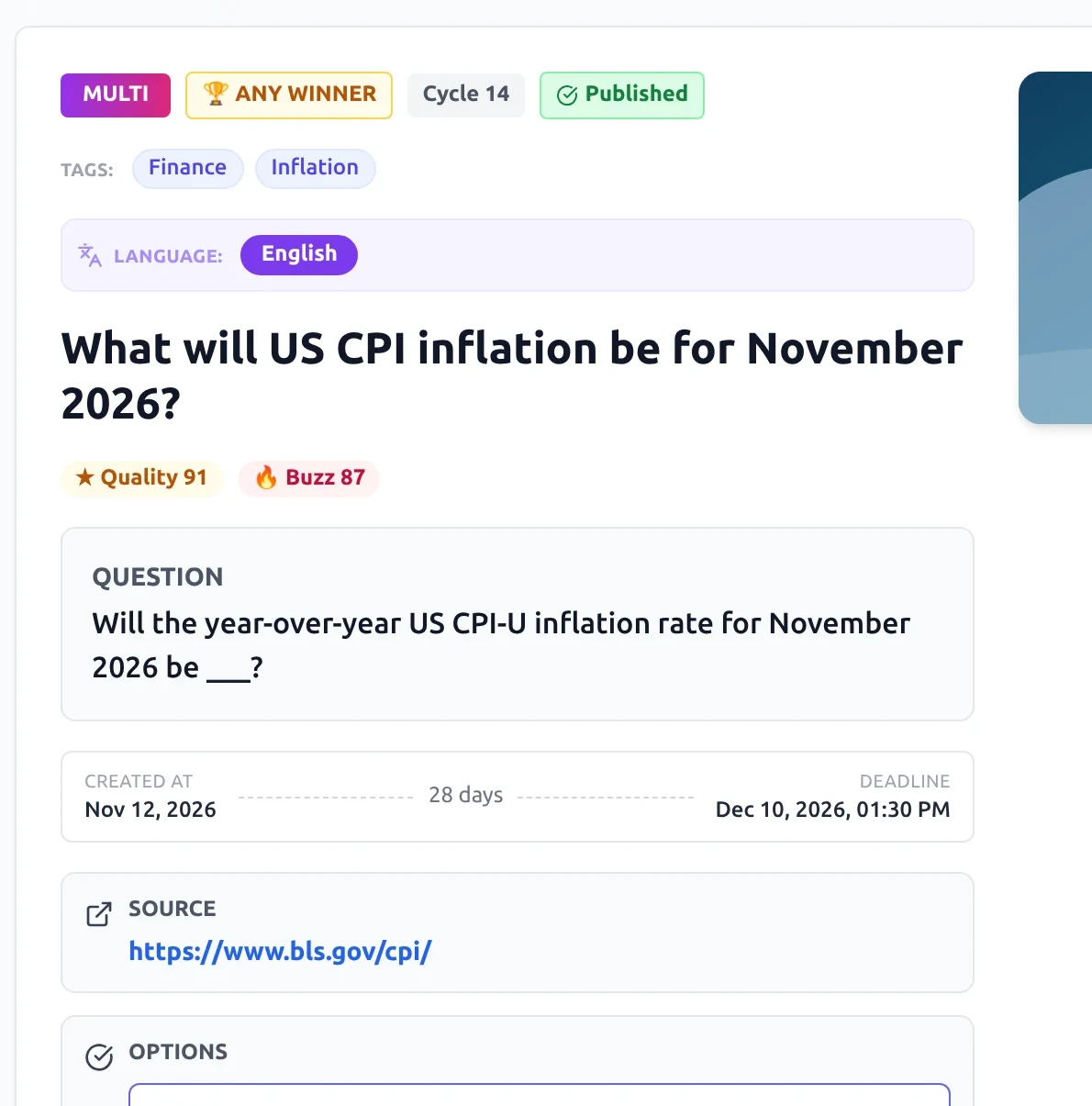
Question, outcomes, rules, deadline, source, image and context, ready to list.
A separate AI reviewer scores every draft from 0 to 100 before it is kept.
Topics, exclusions, trusted sources, schedule, language and categories are yours to set.
Every question records what it cost to create, a few cents of compute.
Your editors approve markets instead of writing them from scratch, or let trusted engines publish on their own.
Market quality
VMAQE is designed to create markets that even experienced human market creators would find impressive.
Buzz Score gauges real topic interest—where an 80 score signals strong participation—while a Question Quality Check ensures clear wording traders understand and want to trade on.
Configurable repeat settings ensure a fresh variety of markets rather than repetitive questions around the same topics.
A feedback layer helps VMAQE refine its market creation intelligence, and improve the quality of its output over time.
Because the true power of AI is not in creating thousands of markets. It is in consistently creating markets worth trading on.
VMAQE in action
A short walkthrough of the VMAQE AI prediction market creator.
SEE IT RUNNING
A live demo shows the stack at work: the AI engines creating, pricing and resolving real markets.
Watch our AI engines create, price and resolve markets on live feeds, from rules set once.
Open the Live AI DemoTalk to a specialist on our platform team and get answers right away
The listing problem
Every market needs research, a precise question, rules and a source. Done by hand, that work becomes the limit on your catalogue.
Markets lag the news, so the traffic peak around a breaking story is missed.
Vague wording and missing edge cases lead to refunds, support load and lost trust.
An outcome that is already known, or a wrong deadline, hands informed traders free money.
Every new topic or language needs more editors before it can go live.
How VMAQE works
Six steps, repeated on your schedule: every 5 minutes to every few days.
TopicExclusionsSchedule
Fresh every cycleDomain lists
OutcomesRulesOdds
9 criteria7 gatesOne rewrite
ImagesTranslationsCost
Review queueAuto-publish
Independent quality scoring
A separate AI evaluator, with live web search, checks every draft.
Only drafts that clear your bar ever reach an editor.
Built to settle
A fixed resolution standard, and a check that rejects anything that breaks it.
Will US CPI be at least 3.0% for November?
No dispute
Source, time window, ties and thresholds, in every market.
Nothing a quick search today could answer.
In the future, in your range, or corrected.
The same angle on the same event is rejected, even reworded.
Clear rules up front mean fewer contested settlements later.
Human control
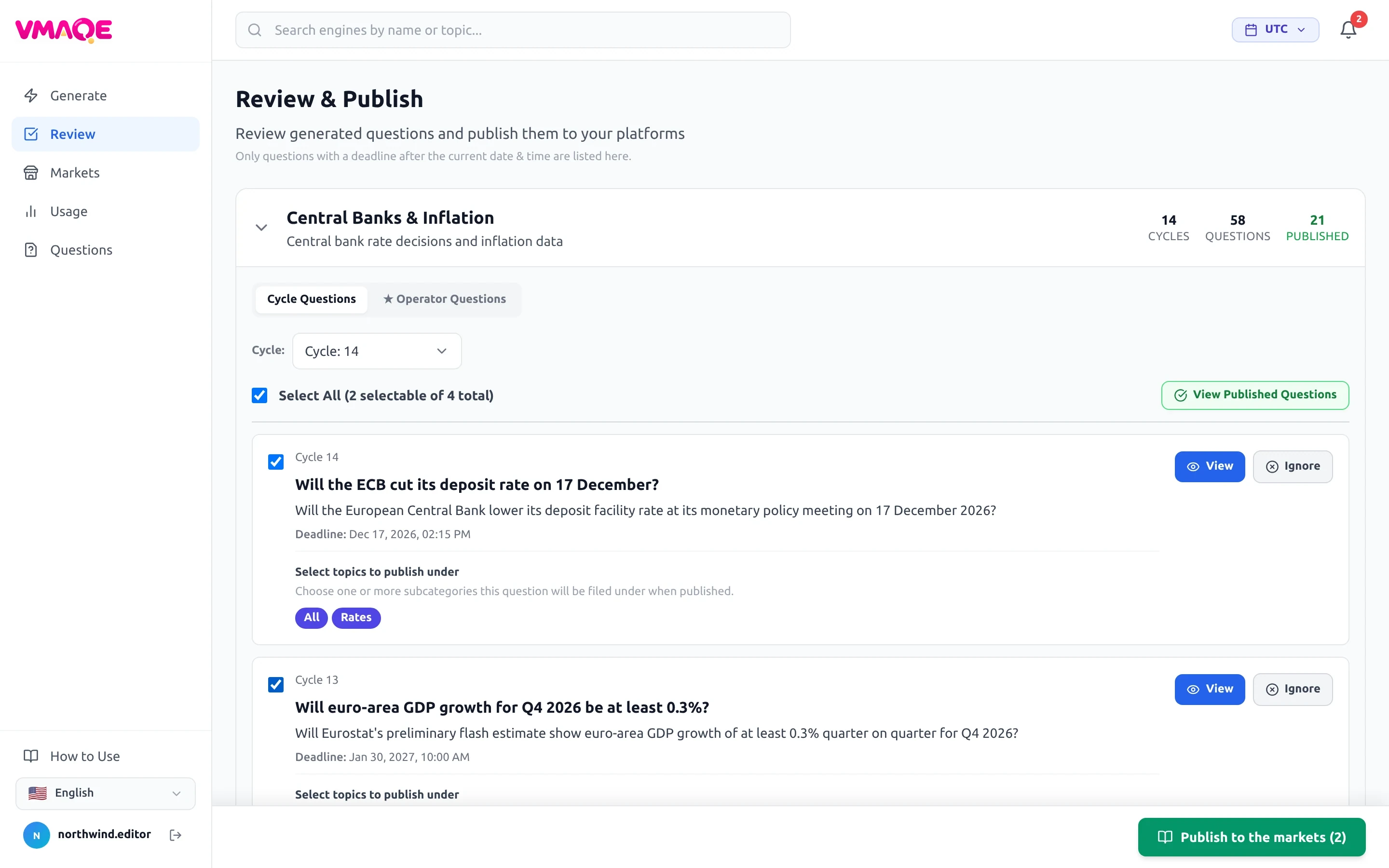
Choose per engine. Either way, your team decides what is listed.
Best for New engines and sensitive topics.
Best for Proven engines on high-volume topics.
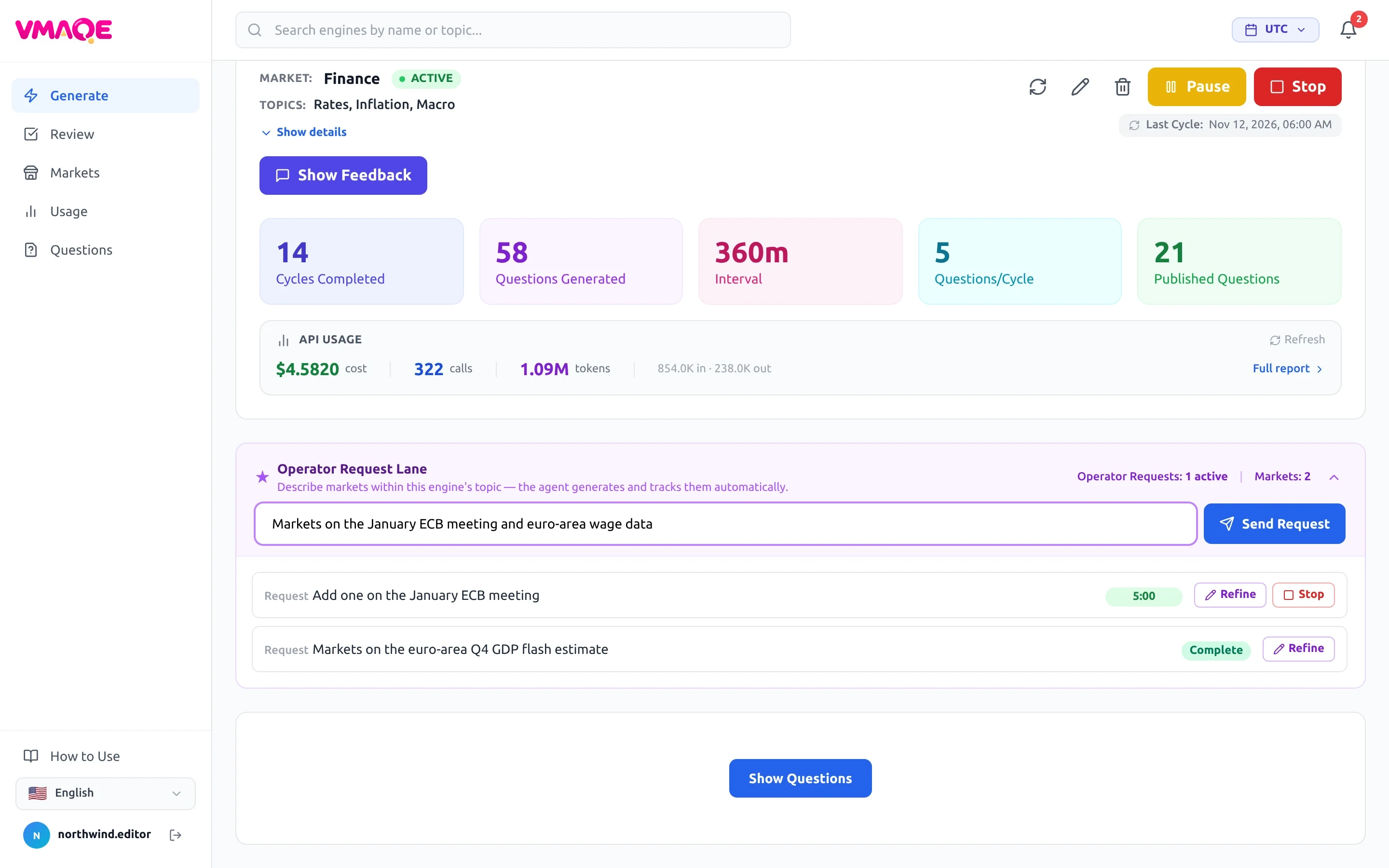
“Markets on tomorrow's product event.”
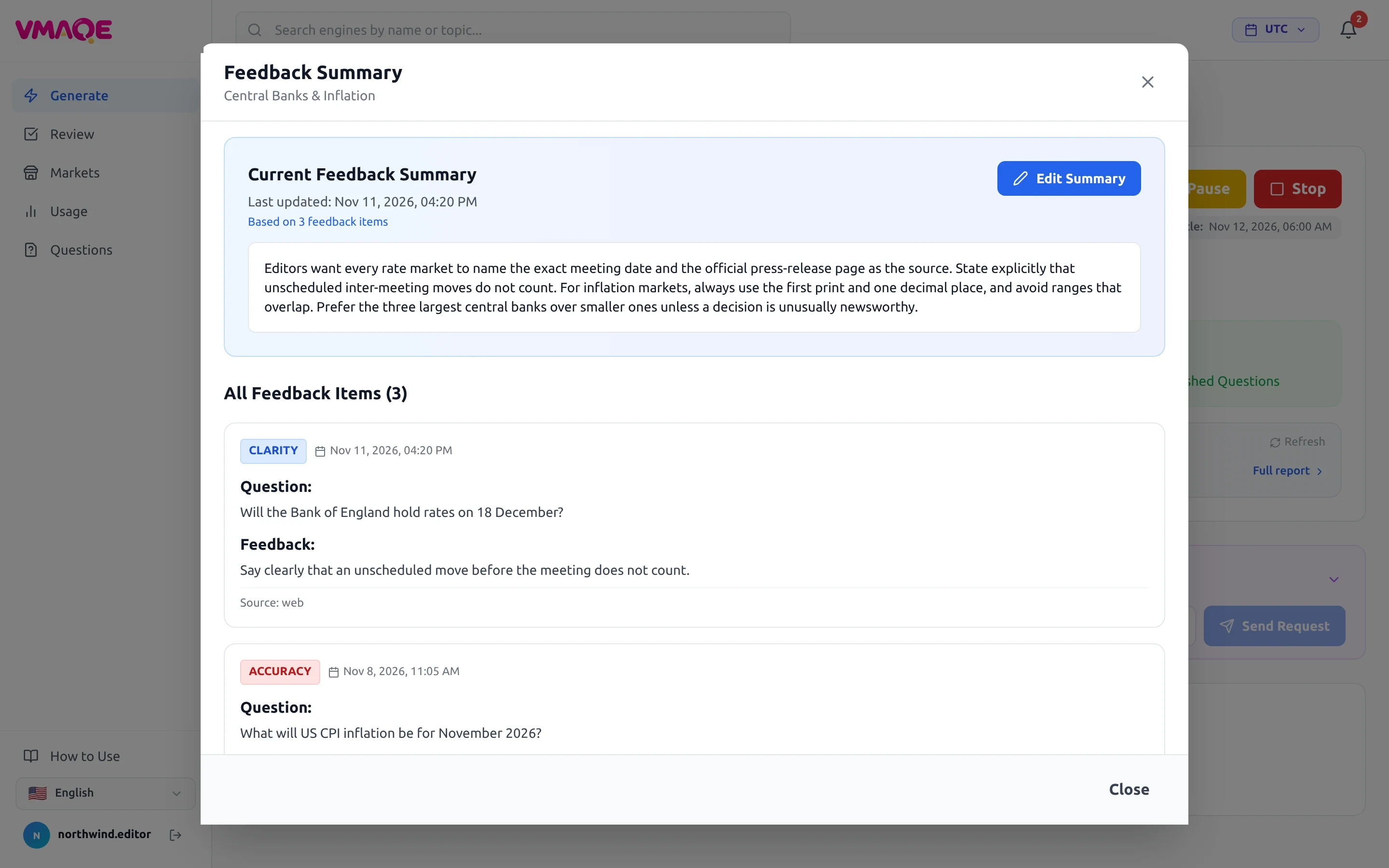
Notes become guidance for every later cycle.
Unit economics
Every search, draft, check and image is logged with its cost.

Every market shape
“Will the central bank cut its deposit rate at its March meeting?”
One option wins from a closed list, such as the nominees for an award plus “Other”.
Several levels can resolve Yes, such as at least 20, 40 or 60 units.
Non-overlapping buckets for a figure such as next month's inflation rate.
“Will the product ship before 30 June?” as a Yes/No with a deadline.
Which of two finishes higher, as a Yes/No or a multi-option market.
Who it is for
Keep a fresh, broad board without a large listing desk.
Add politics, entertainment and tech markets in your own language.
Turn your news coverage into prediction questions.
A daily supply of questions for games and contests.
Native-language markets on local news.
Inside VMAQE
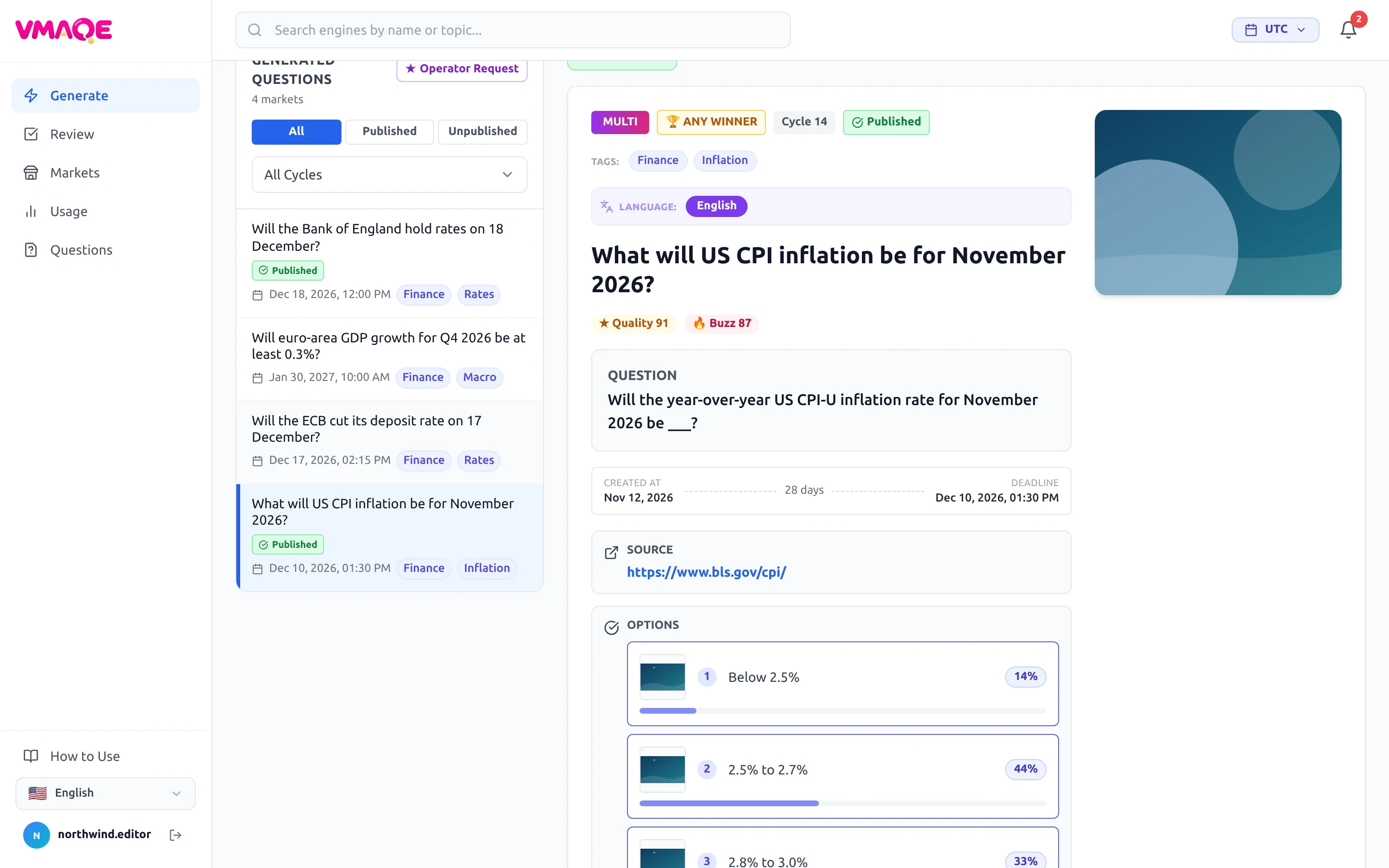
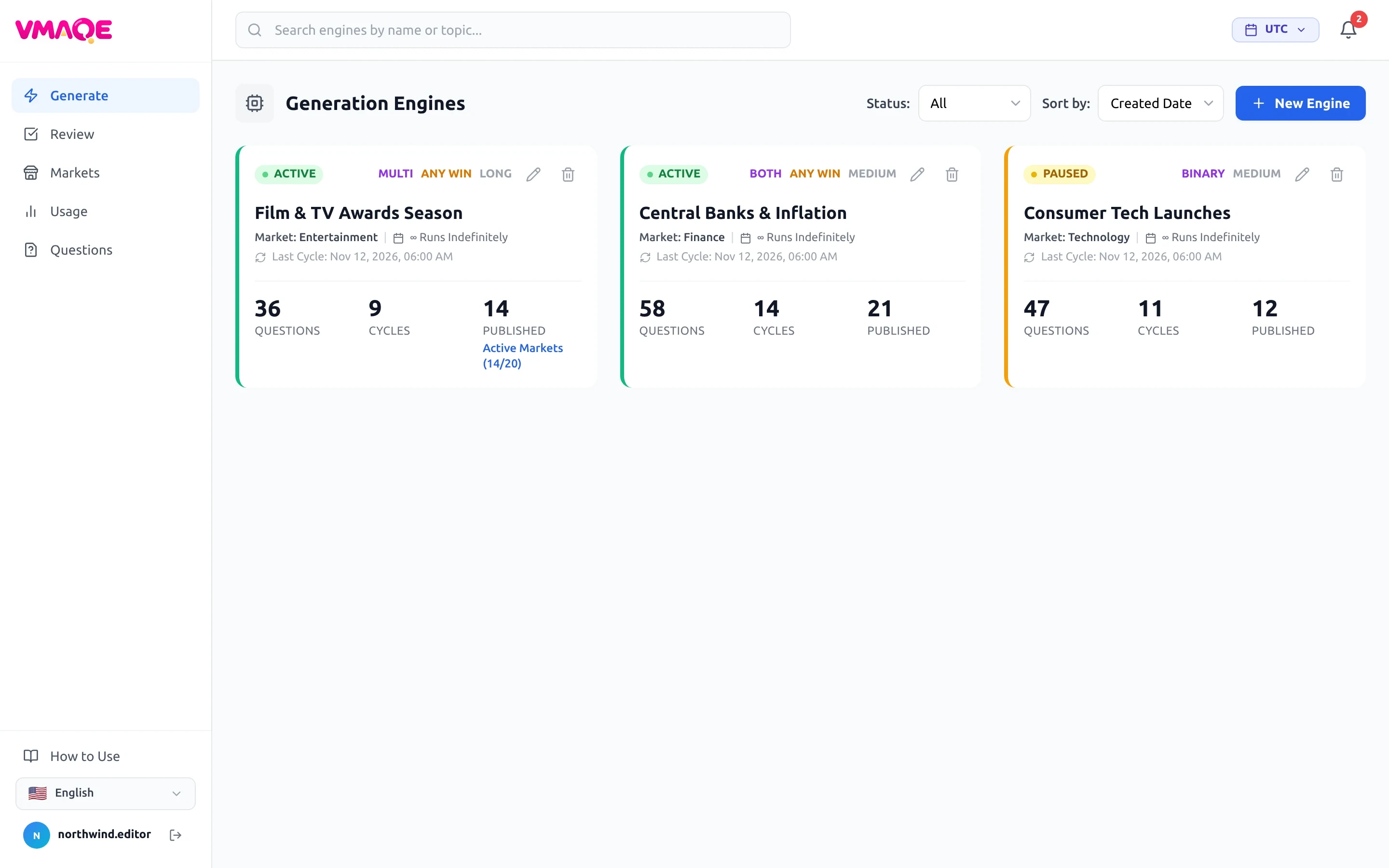
Real VMAQE admin screens, shown with fictional data.
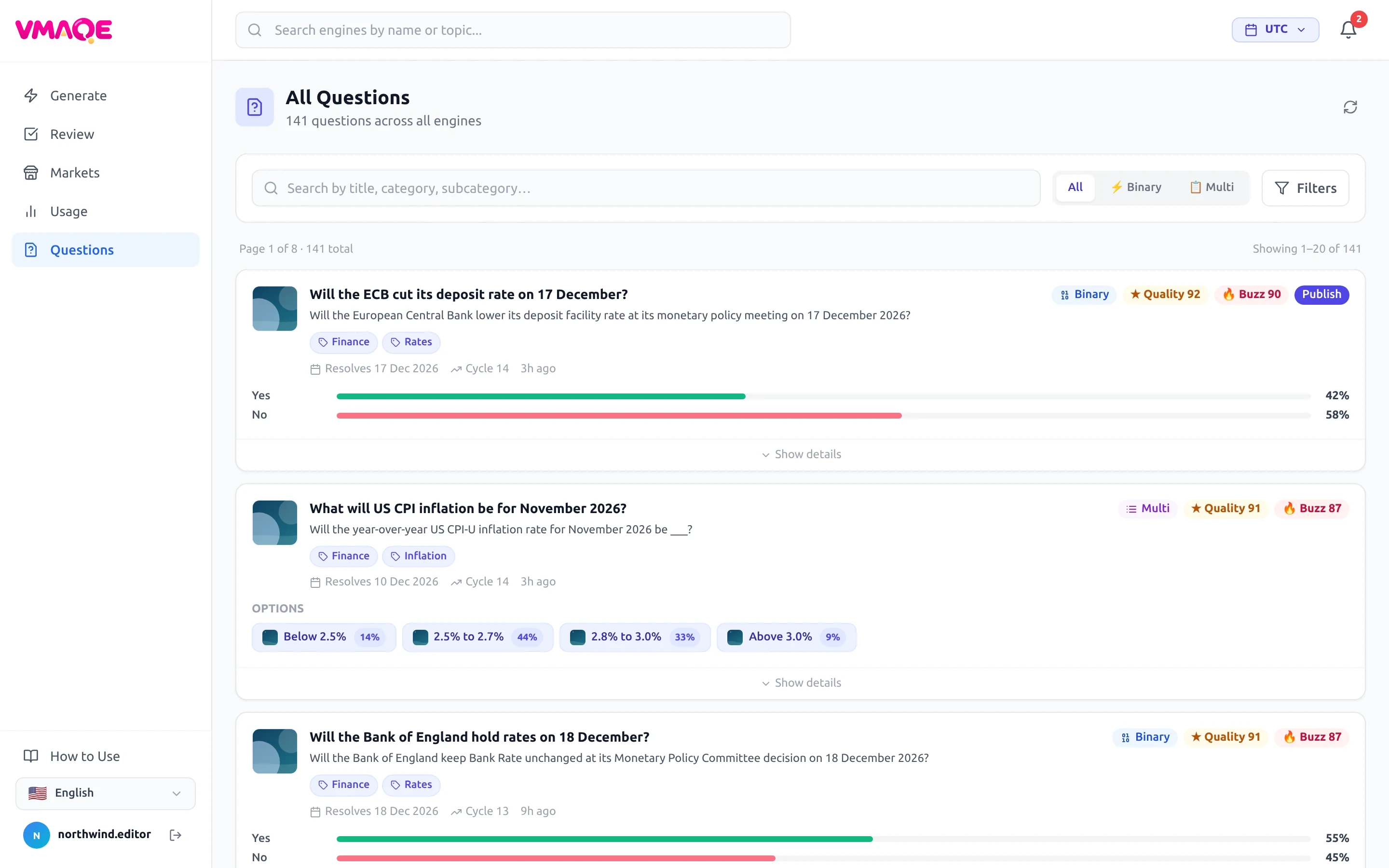
All Questions: search and filter every AI-drafted market by type, quality, buzz and status.
FAQ
A complete, ready-to-list market: a short headline, the full question, outcomes, written resolution rules with edge cases, a deadline, a resolution source link, a cover image, background context, tags and starting probabilities. Multi-option markets are also split into one Yes/No market per option. Each one carries an independent quality score, a demand score and its compute cost.
From a fresh web search on every cycle, across news and web pages. You can restrict it to trusted domains. It does not read RSS feeds, fixture calendars, social media or uploaded files, so market ideas come from what is in the news and on the web at that moment.
Three layers. The writer follows a resolution standard covering sources, ties, cancellations and corrections. A validator rejects drafts with unverifiable outcomes, mismatched options or outcomes already known. Then an independent AI reviewer scores every draft on nine criteria and seven pass/fail gates, including “ambiguous” and “already resolved”. Near-misses get one rewrite; the rest are dropped.
That is your choice. By default, markets wait in a review queue where editors can edit any field, translate, reject, ignore or publish. You can turn on auto-publish per engine: VMAQE then assigns the right sub-categories and publishes, and holds any question that fits none of your categories, with a reason and a notification.
Yes, through written feedback, not model training. When an editor writes feedback, VMAQE merges it into a short guidance note for that engine, and the note shapes every later cycle. Editors can read and rewrite the note. Rejecting or editing a question does not change future output by itself, and no model is fine-tuned on your data.
A few cents of compute. Each question records its share of its generation cycle's AI and search spend, including the drafts that were rejected. Your cost depends on the models you choose for each role. The usage page shows spend by engine, cycle and call, with daily and total alerts.
Yes/No markets; multi-option markets with a single winner; threshold ladders where several levels can resolve Yes; numeric ranges as non-overlapping buckets; and markets bound to a date, such as “before 30 June”. An engine can produce only Yes/No, only multi-option, or a mix.
Forty-seven, including English, Spanish, Portuguese, French, German, Arabic, Hindi, Bengali, Tamil, Chinese, Japanese, Korean and Swahili. An engine can write natively in its chosen language, and every question can be translated into the languages you select. The admin interface itself is available in fifteen languages.
Each engine's recent questions are passed to the writer, and both the validator and the independent reviewer reject the same angle on the same event. A different threshold or a rewording of an existing market counts as a duplicate. You can switch duplicate avoidance off for engines that repeat formats on purpose.
VMAQE publishes through an API in a structured format: title, rules, source, image, dates, category, topics, outcomes with starting probabilities, and translations. Other platforms can pull questions over the REST API, or map the publish format to their own endpoint.
The operator. VMAQE drafts, checks and scores markets, but your team, or your auto-publish setting, decides what is listed. You control the topics, sources and exclusions, and you own the exchange, pricing, risk and compliance in your jurisdictions. Vinfotech provides and supports the software.