Evidence-backed
Every move comes from public evidence, with the finding and source that caused it.
VPULSE reads fresh public evidence, updates each question's odds with an estimated range, and shows the sources and cost behind every move.
Guardrails on every move. A daily budget on every question. Sources on every update.
What VPULSE is
An up-to-date probability on every question you list, including the long tail no odds feed covers.
VPULSE searches the web for new evidence on each question, and auditable code applies only what changed to the last probability.
Safety checks decide what is published, and every update shows its range, sources and cost.
Every move comes from public evidence, with the finding and source that caused it.
Each probability carries a range, so you can see how settled it is.
No AI model can publish a number. Deterministic checks decide.
Spend follows activity, under a hard daily cap on every question.
Probabilities that move when the evidence does, and not before.
VPULSE in action
A short walkthrough of VPULSE, live AI probability for every market.
SEE IT RUNNING
A live demo shows the stack at work: the AI engines creating, pricing and resolving real markets.
Watch our AI engines create, price and resolve markets on live feeds, from rules set once.
Open the Live AI DemoTalk to a specialist on our platform team and get answers right away
The pricing problem
A big catalogue outgrows any desk. The long tail ends up priced by guesswork, or not listed at all.
Nobody follows the news for every question, so informed traders pick off stale prices.
Every question is re-checked on its own schedule, from every 5 minutes to every 12 hours.
Novel questions on tech, politics or niche sports have no feed to copy from.
Prices come from public evidence, so questions no odds feed covers still get one.
Hand-set odds leave no trail, which hurts disputes, trust and internal review.
Every move links to the finding and source that caused it, kept on an immutable record.
One bad model output can move a market badly, with no limit on what it costs.
Code-only guardrails cap every move, and each question has a hard daily budget.
How VPULSE works
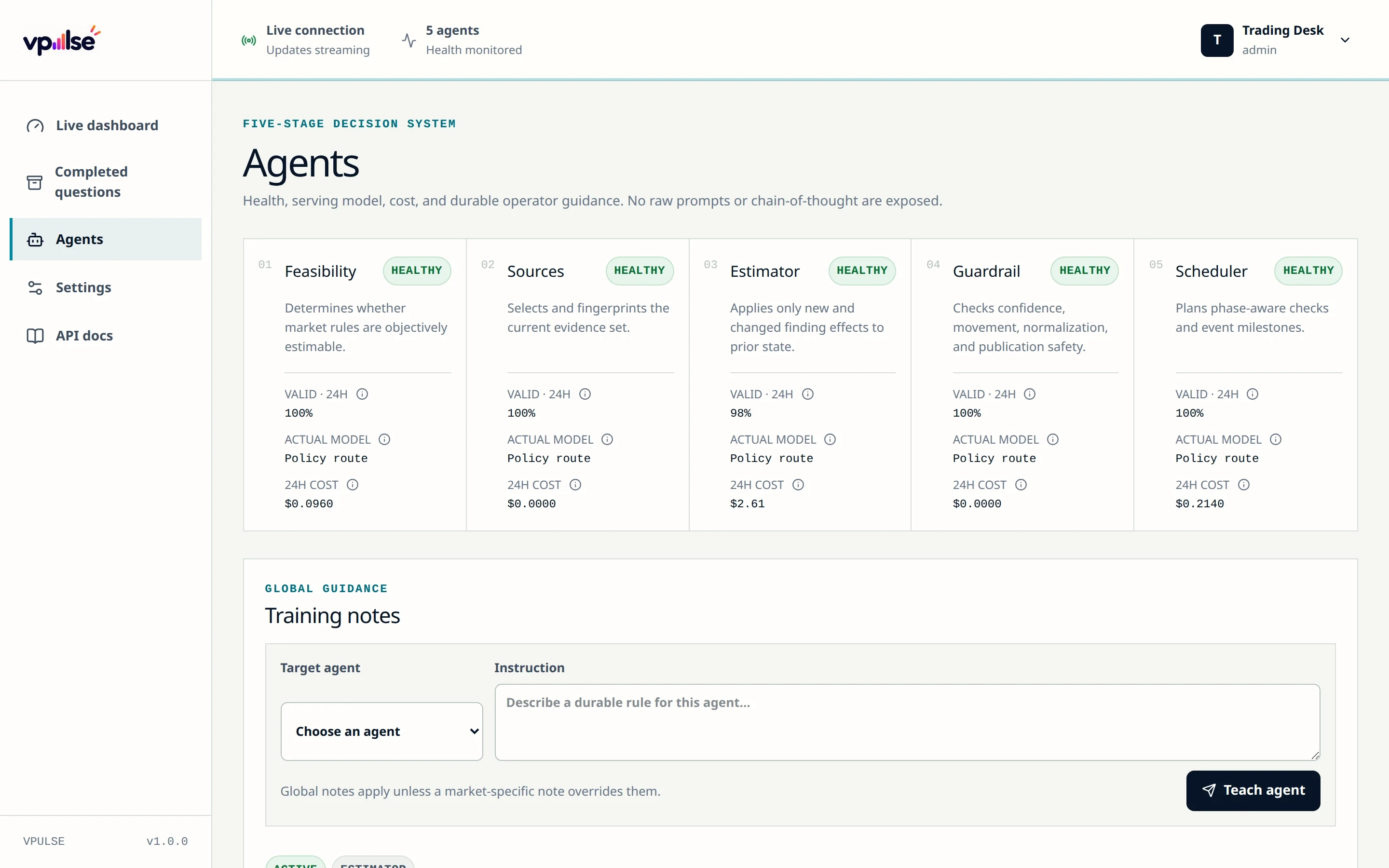
Six steps on every question, with one rule: AI proposes, code decides.
APIRulesDeadline
ObjectiveTime-boundResolvable
Web evidenceFingerprints
NewUpdated>5% trigger
GuardrailSecond modelHold
Next checkOne resolution
Incremental updates
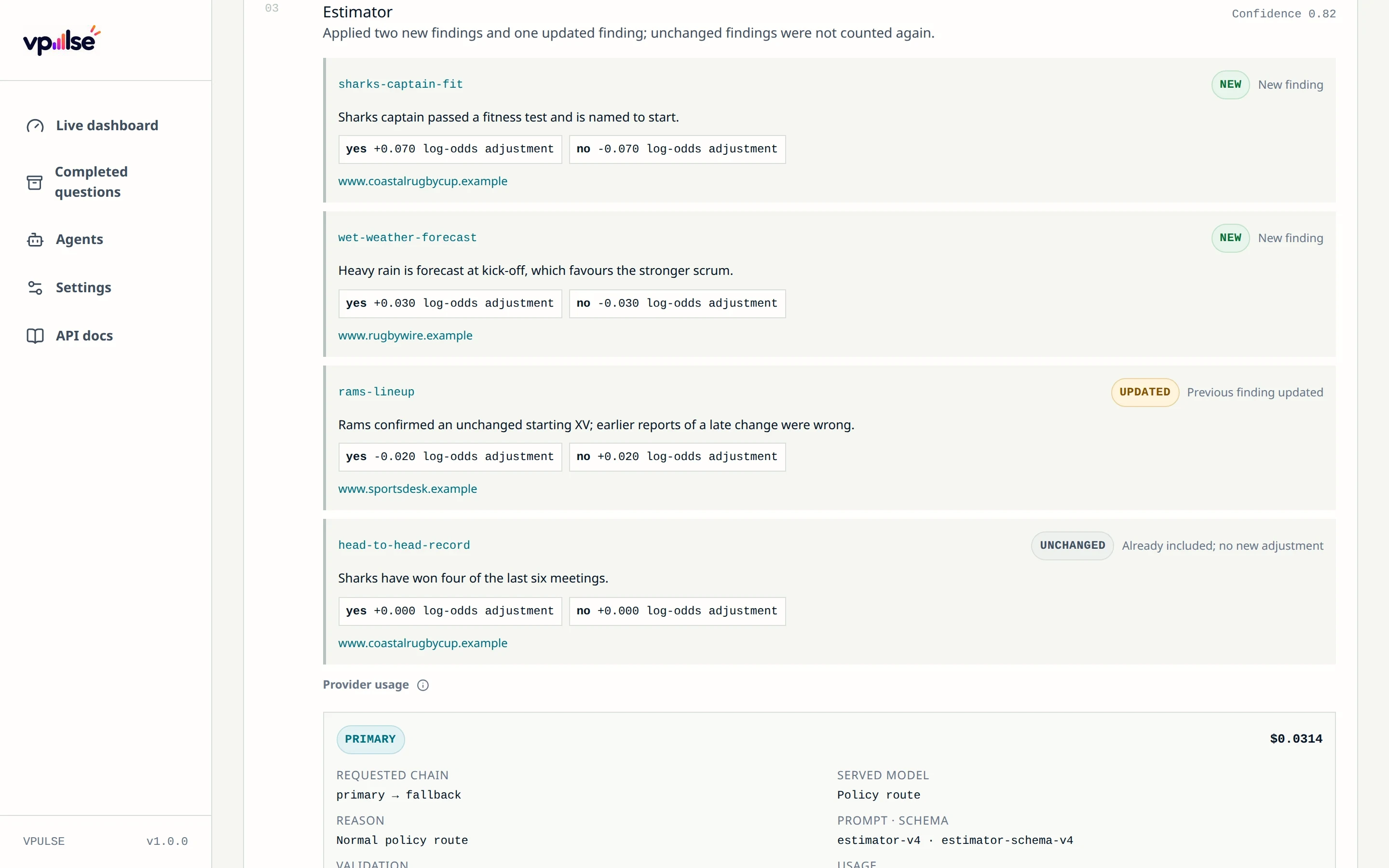
VPULSE never asks a model for a fresh number. It keeps the last probability and adds only the effect of what is new, so old news is never counted twice.
Inside the cap: published
Playing a demo. Drag any slider to try it yourself.
An illustration of VPULSE's update rule, using findings like those on the evidence screen. In the product, each effect is proposed by the AI from real evidence and checked by code.
Any news that triggers a move of more than 5% in probability is instantly captured, with every move linked to the finding and source that caused it.
AI proposes, code decides
A code-only guardrail checks every proposal. If anything fails, VPULSE keeps the last good value and shows why.
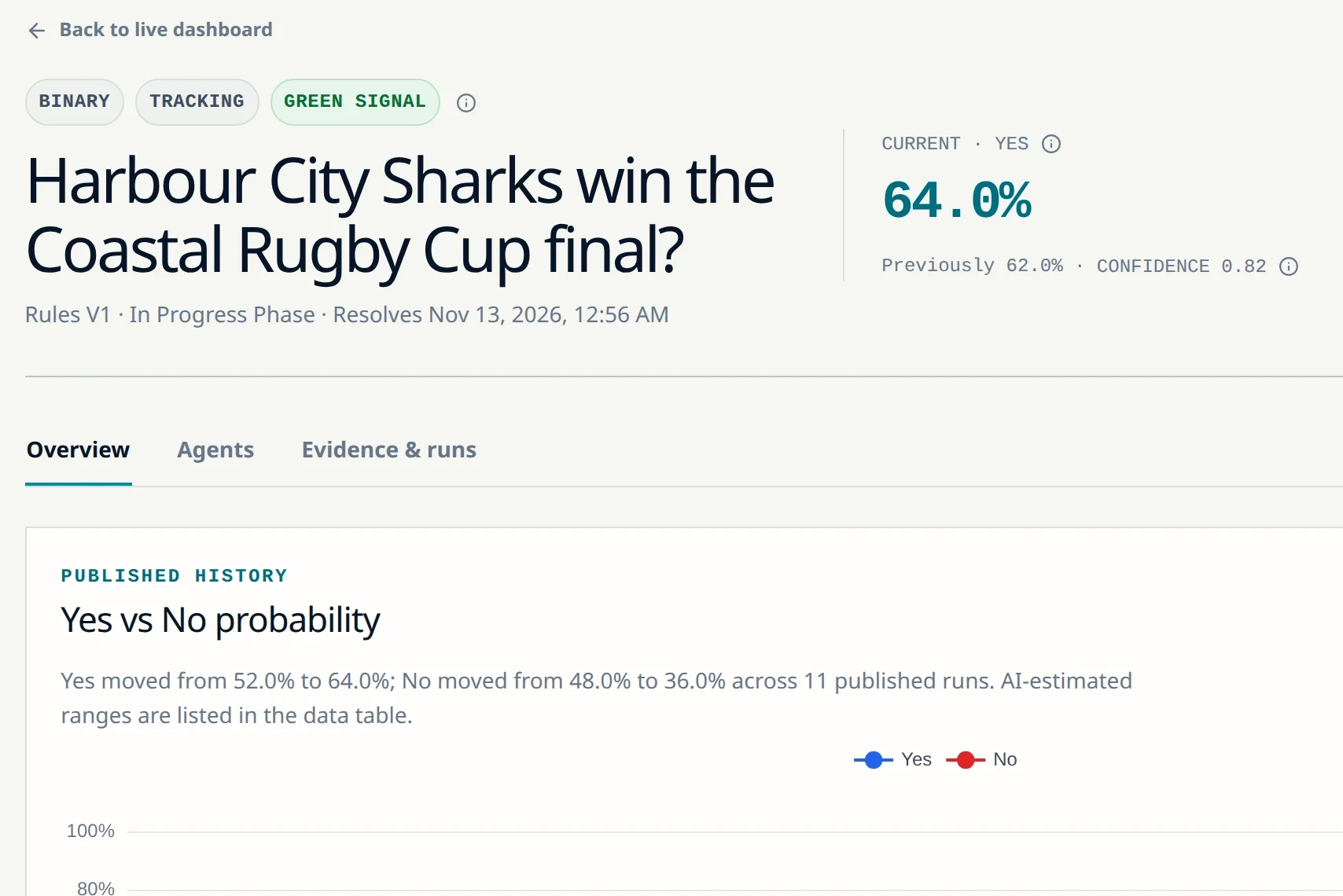
Captain passes fitness test
63.9%
At least two evidence items before anything is published.
An evidence confidence score of at least 0.50, by default.
The range must contain the probability, and stays within 10 points of it.
A move above the phase cap needs a second, independent model to agree, or it is capped.
Operators never see a silently broken price.
Adaptive checks
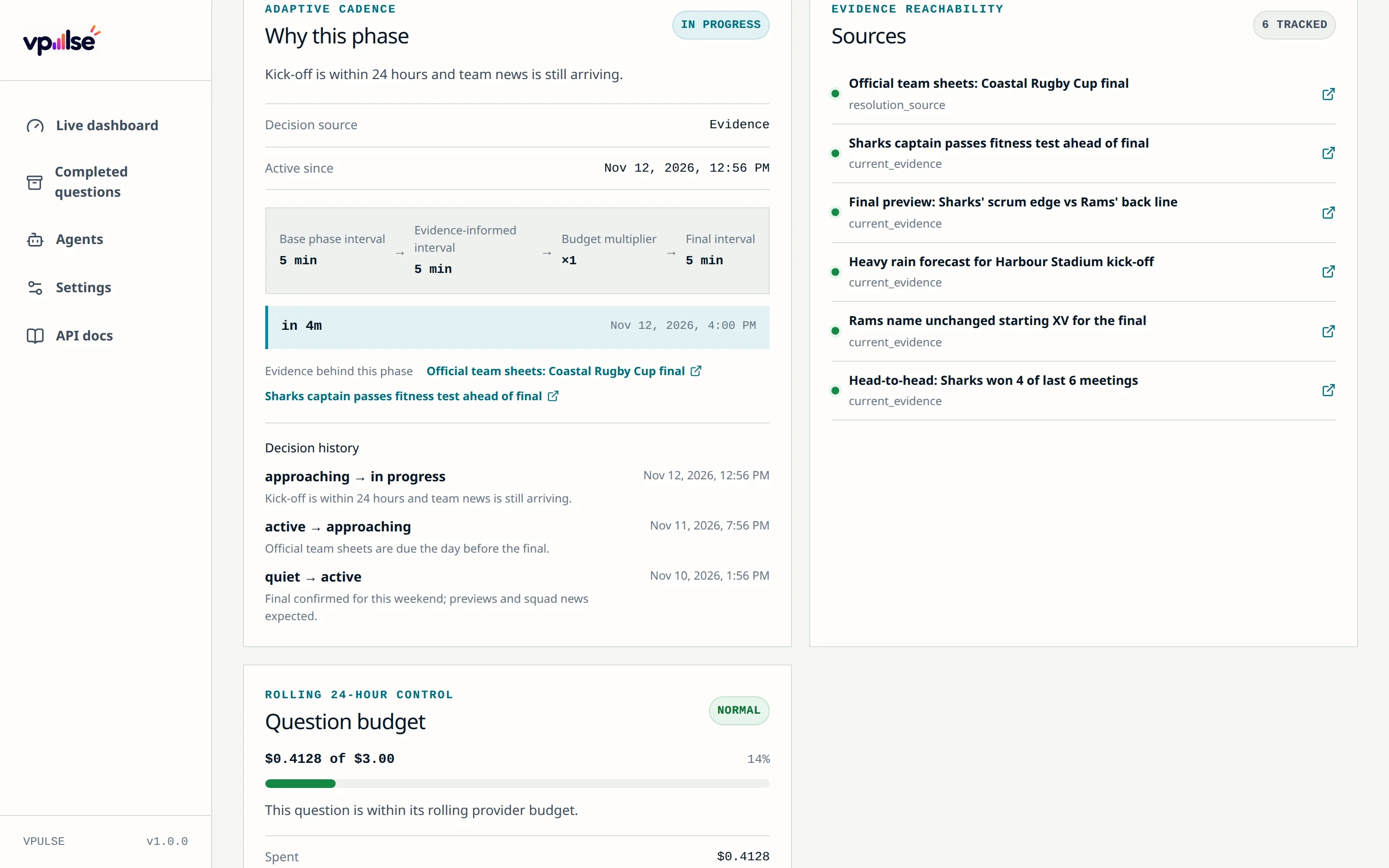
Each phase sets the check rhythm, which backs off when nothing changes.
Check rhythm by phase
Daily budget, per question
Control and record
Your team steers the engine, and every run leaves a record.
Pause, run, edit rules or leave guidance, one question at a time or in bulk.
There is no box to type in a probability.
Findings, fingerprints, models, cost and the publish-or-hold decision.
Prompts and model reasoning are not stored.
What it can price
Integration
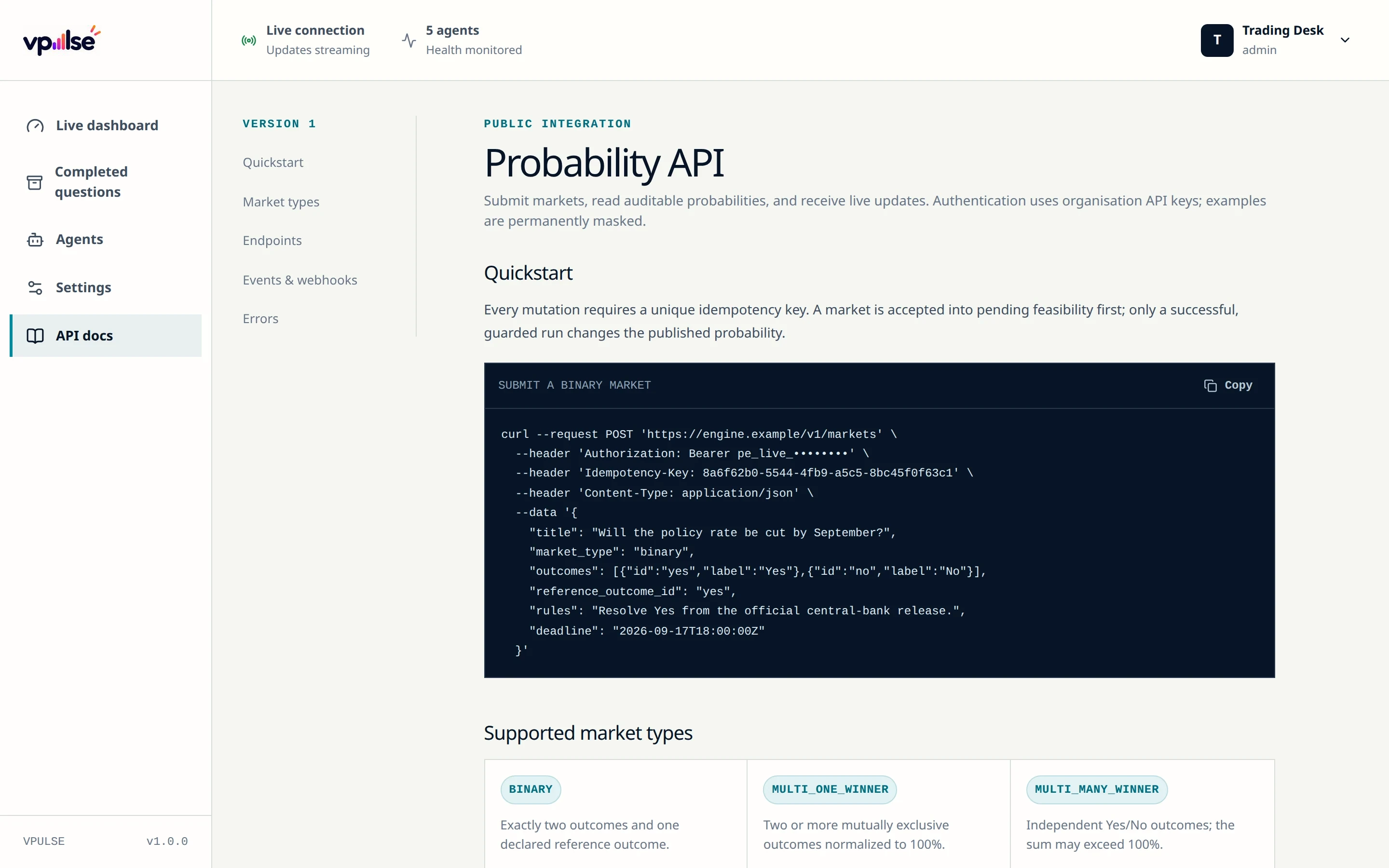
A small REST API with organisation keys: submit questions, read probabilities, and receive updates as they happen.
/v1/marketsSubmit a question/v1/markets/{id}New rules version/v1/markets/{id}/probabilityLatest probability/v1/markets/{id}/schedulePhase and next check/v1/markets/{id}/historyPublished history/v1/markets/{id}/eventsLive event stream/v1/webhooksSigned webhooksFollow a market's events live, or receive signed webhooks retried for up to 24 hours.
A failed run keeps the last published probability. Stale values are labelled, never blanked.
Who it is for
A credible reference probability on every listed question, including the long tail.
Prices for questions no odds feed covers: tech, politics, entertainment.
See when a price drifts from the evidence, with the reasons attached.
Live “chance of” figures with sources, to engage your audience.
Reference odds for questions in games and contests.
Bring a few of your questions to a demo and watch VPULSE price them.
Inside VPULSE
Real VPULSE console screens, shown with fictional data.
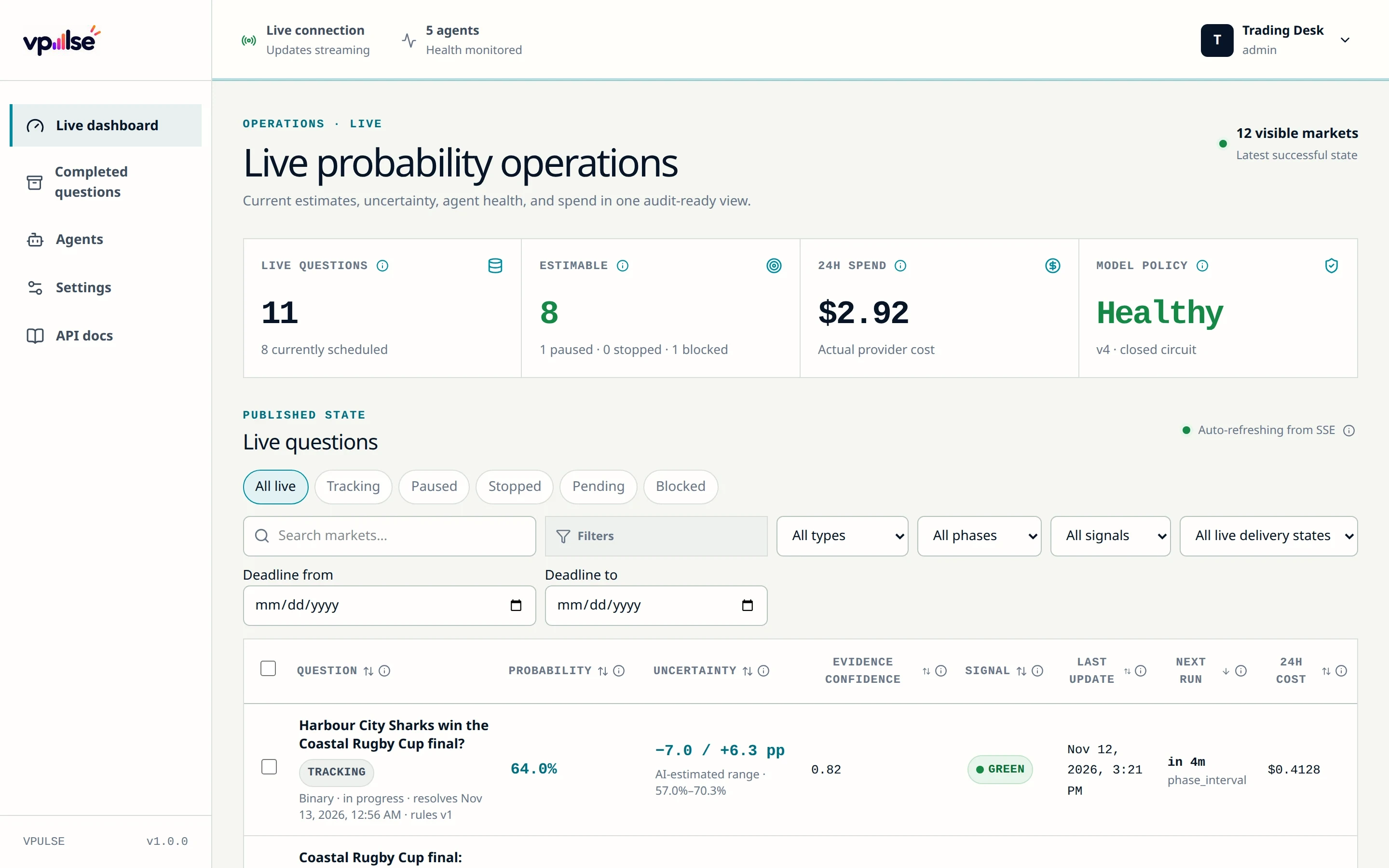
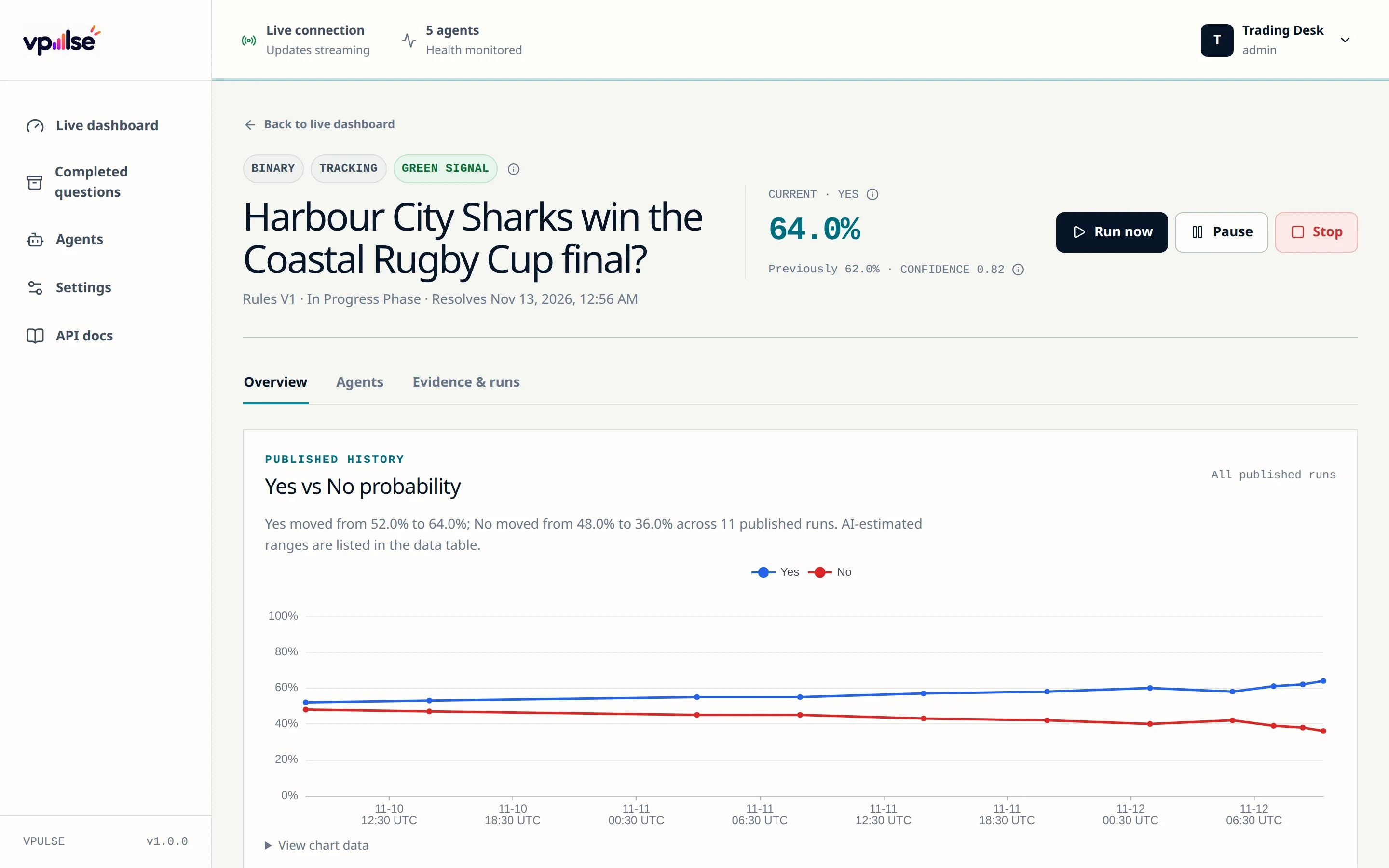
Live Dashboard: every question's probability, estimated range, next check and 24-hour cost.
FAQ
For each question you list, VPULSE publishes a probability for every outcome, an AI-estimated range, the time it was calculated, a short explanation and the sources it relied on. It also reports when the next check is due and what the question has cost. Your platform decides how to use these numbers: display, reference odds or internal risk.
From current public web content found through a search service: news, official sites, league tables, statistics pages and press releases. It does not use bookmaker odds, exchange prices or your own market's price as input. Each fact is fingerprinted, so VPULSE can tell what is genuinely new since the last update.
No. An AI model reads the evidence and proposes how much each new or changed fact should move the probability. Deterministic code then applies the change, calculates confidence and runs the guardrails. A code-only guardrail decides whether anything is published. Large moves need confirmation from a second, independent model, or they are capped.
It is an AI-estimated range around the probability, limited to at most 10 percentage points either side. It signals how settled the estimate is. It is not a statistical confidence interval and does not promise that outcomes fall inside it a set share of the time. Final results are shown as exact 100% or 0%.
It depends on the question. By default, quiet questions are checked about every 12 hours, active ones hourly, those with an event coming soon every 15 minutes, and those underway or in their final 24 hours every 5 minutes. When nothing new is found, checks back off. Nothing is checked more often than every 2 minutes.
By default each question has a hard budget of $3.00 per rolling 24 hours, of which $0.25 is reserved for settling the result. Checks slow down as the budget fills, and the AI estimate is skipped when evidence hasn't changed. The console shows every question's spend by operation.
VPULSE never replaces a good number with a bad one. If the AI returns invalid output, it tries a fallback model. If evidence is missing or confidence too low, it holds the last published probability and shows a red signal with the reason. Outdated values stay visible but are labelled stale, and alerts notify the operations team.
Yes/No questions, multi-option questions with one winner, and multi-option questions where several options can come true independently. Any topic works if the rules are objective and name a resolution source. VPULSE blocks vague questions, such as “Will the festival be a success?”, and explains why. Numeric markets need to be expressed as outcome buckets.
Yes. Operators can pause, resume, stop or restart any question, trigger an immediate check, edit rules, and leave standing guidance notes for individual agents. Admins tune intervals, movement caps, confidence thresholds and budgets in Settings. There is no option to type in a probability by hand. Changes always come from evidence.
Through a REST API secured with organisation keys: create questions, then read the current probability, schedule and history. Updates can also arrive through an event stream or signed webhooks, which are retried for up to 24 hours.
VPULSE provides reference probabilities and evidence. The operator writes the market rules, decides how to use the numbers, sets prices and margins, holds funds and risk, settles markets, and is responsible for regulatory compliance in its jurisdictions. VPULSE output is not betting or financial advice.
OUR BLOG