Prediction Market Need a Constant Supply of Good Questions
A prediction market platform does not grow only because it has a trading screen, wallet system, matching engine or admin panel. It grows when users keep finding fresh, relevant and well-framed markets that they want to trade.
This is where many operators struggle.
A strong market question has to be timely enough to attract attention, clear enough for users to understand, objective enough to resolve later and structured enough to become a tradeable contract. It must avoid vague wording, duplicate topics, unclear deadlines and outcomes that cannot be verified. Doing this manually across sports, finance, politics, crypto, technology, entertainment and regional categories quickly becomes a serious operational bottleneck.
That bottleneck is not just a content problem. It is an infrastructure problem.
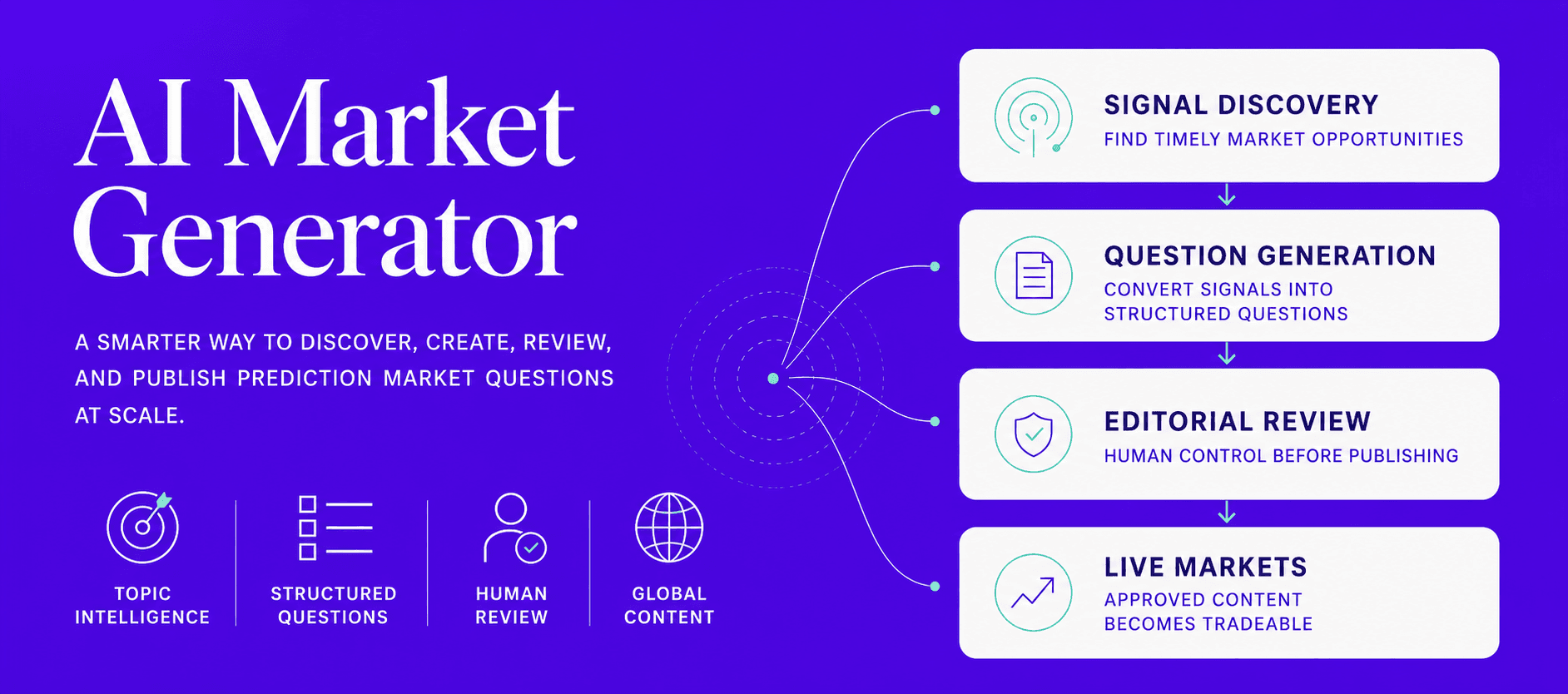
An AI Market Generator helps prediction market operators turn market creation into a repeatable workflow. Instead of relying only on manual research and one-off drafting, operators can configure generation engines, create candidate questions, review them, apply feedback and publish approved markets into the live platform.
The goal is not to remove human judgment. The goal is to give operators a faster, more consistent and more scalable way to create prediction market content.
1. The Prediction Market Content Bottleneck
Every active prediction market platform needs a steady pipeline of new events. Users return when there are markets around topics they care about right now. Operators grow when they can cover multiple categories without waiting for a small editorial team to manually research, write and structure every market.
The difficulty is that good market creation is harder than it looks.
A publishable market must answer several questions:
- Is the topic current and interesting?
- Is the question clear and objective?
- Are the possible outcomes properly defined?
- Is there a deadline or settlement window?
- Can the result be verified from reliable sources?
- Is it too similar to something already published?
- Does it fit the platform's category strategy and compliance posture?
When teams manage this manually, quality depends heavily on individual editors, available research time and how quickly the team can react to breaking developments. As volume grows, the process becomes slow, inconsistent and expensive.
This is the content bottleneck: the platform needs more markets, but manual operations cannot create enough high-quality, resolvable questions at the required speed.
2. What an AI Market Generator Actually Does
An AI Market Generator is not simply a prompt box that writes random questions. For serious prediction market operators, it needs to work as an operational system.
A practical generator should help operators move through a structured workflow:
- Define the market strategy.
- Configure the generation engine.
- Generate candidate questions.
- Check quality and relevance.
- Route questions for human review.
- Capture feedback.
- Publish approved questions into the live prediction market platform.
This is where AI-assisted workflows become valuable. The AI helps with research, drafting, structuring and variation. The operator still controls what gets approved, what gets rejected and what goes live.
That distinction matters. Prediction market technology has to balance speed with trust. A market that is generated quickly but written badly can create confusion, disputes and settlement friction. A good AI Market Generator reduces manual work while keeping governance in place.
3. From Topic Strategy to a Configured Generation Engine
The first step in scalable market creation is not generation. It is configuration.
Operators should be able to define the subject area, language, category, subcategory, operating mode, event subject and editorial instructions. This gives the generator a clear boundary. It prevents the system from drifting into irrelevant topics or producing markets that do not match the platform's strategy.
For example:
- A sports engine may focus on upcoming fixtures, tournament questions or match-specific outcomes.
- A finance engine may focus on earnings, indices, macro releases, asset prices or company events.
- A politics engine may focus on elections, public announcements or measurable policy outcomes.
- A technology engine may focus on product launches, regulatory decisions, AI announcements or public-company milestones.
- A regional engine may generate content in a local language for a specific audience.
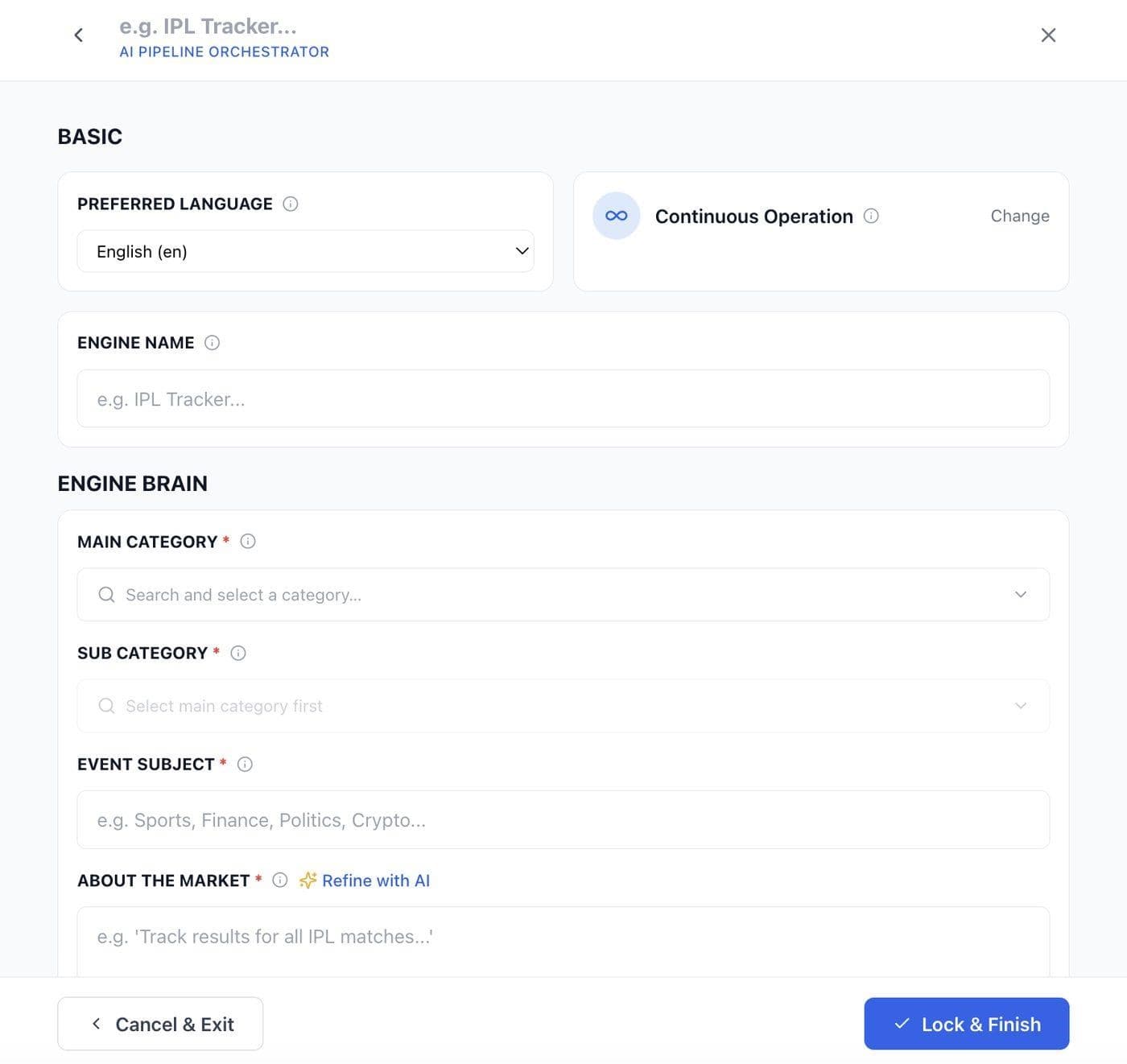
AI Pipeline Orchestrator: operators define language, operating mode, category, event subject, and market instructions before generation begins.
In Vinfotech's current product workflow, operators can configure an AI Pipeline Orchestrator with fields such as engine name, preferred language, operating mode, category, subcategory, event subject and market description. These inputs work like an editorial brief for the generation engine.
This is what makes the system useful for real operators. The generator is not writing in isolation. It is creating candidates inside a defined market strategy.
4. The Question Generation Lifecycle
Once the engine is configured, the generation process follows a lifecycle. This gives structure to the entire market creation workflow.
A typical lifecycle includes:
- Topic setup: The operator defines the market area and editorial boundary.
- Signal discovery: The system looks for relevant opportunities connected to the configured topic.
- Question creation: Candidate market questions are generated with titles, options, deadlines and resolution direction.
- Quality checks: The system helps identify weak, vague, repetitive or low-value questions.
- Review workflow: Operators inspect, edit, ignore, select or approve candidate questions.
- Publishing: Approved questions are pushed into the live prediction market platform.
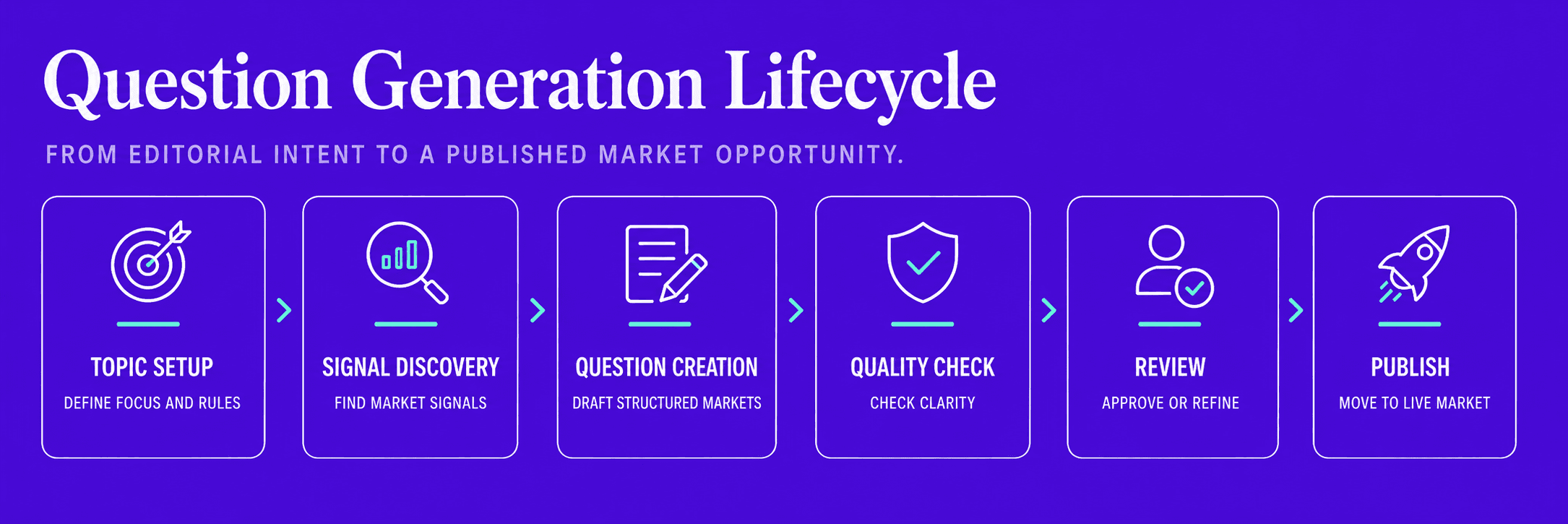
Question generation lifecycle: topic setup, signal discovery, question creation, quality check, review, and publish.
This separation of stages is important. It turns market generation from a loose creative task into a controlled operating pipeline.
For enterprise operators, this structure reduces several risks at once: irrelevant content, unclear rules, duplicate questions, poor category fit, weak resolution criteria and accidental publishing.
5. Review Workflow: Automation With Editorial Control
Automation is only useful when operators can control it.
A prediction market operator should not be forced to publish every question the AI generates. Some ideas may be valid but not timely. Some may be too similar to existing markets. Some may need stronger wording. Some may not fit the campaign or category strategy.
Vinfotech's current AI Market Generator includes a review workflow where generated questions are grouped by engine and generation cycle. Operators can inspect the output, compare questions, select the ones worth publishing and ignore the ones that are not useful.
This matters because multiple engines may be running across different categories. A sports engine, finance engine and politics engine may each produce several questions per cycle. Without a clear review layer, the team would still spend a lot of time tracking what was generated, what was checked and what is ready to publish.
A strong review workflow keeps the human team focused on judgment rather than administrative tracking.
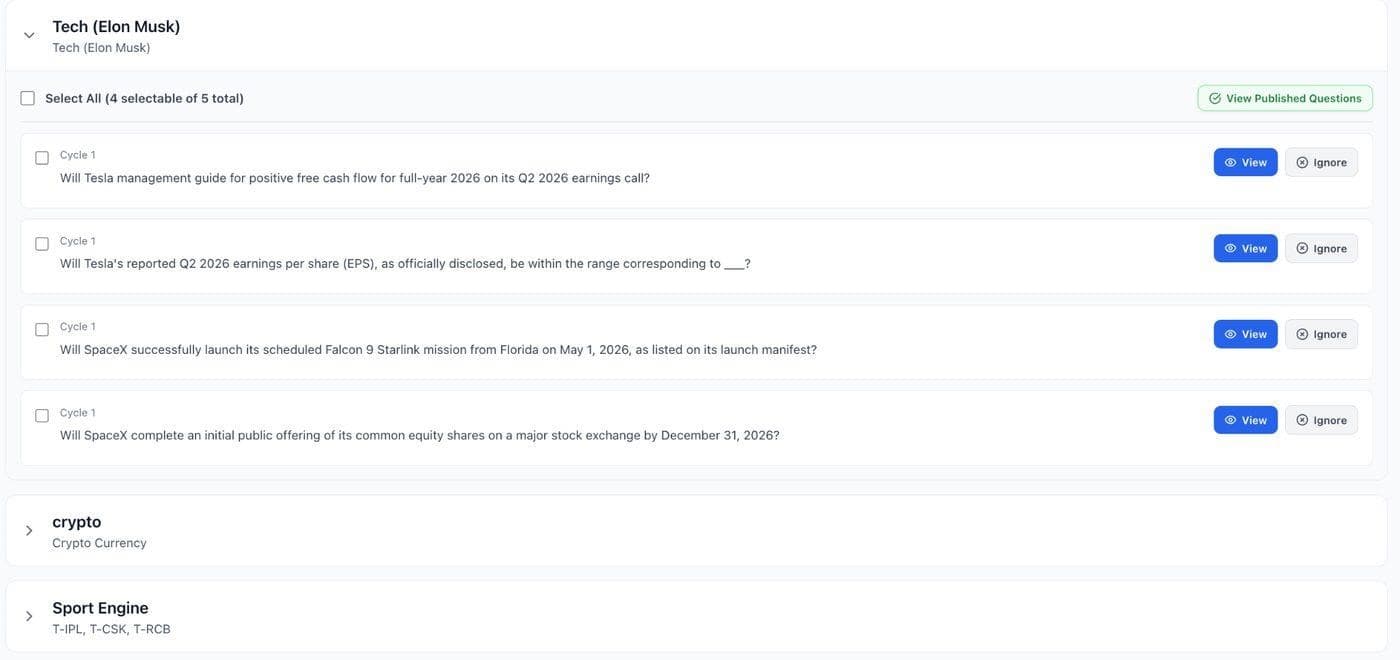
Review workflow: generated questions are grouped by engine and cycle so operators can inspect, select, ignore, or publish content efficiently.
6. Feedback Loop: Making the Generator Better Over Time
Market teams usually develop their own editorial standards over time. They learn which questions are too broad, which outcomes create disputes, which categories need strict source rules and which wording patterns work best for their users.
The AI Market Generator should learn from that operational judgment.
Vinfotech's current workflow includes a feedback layer that allows operator feedback to be captured and summarized. When teams flag questions as too broad, repetitive, unclear or off-category, those signals can help future generation become more aligned with the platform's standards.
This is an important shift. The generator is not just a one-time content tool. It becomes a market operations system that can gradually reflect the operator's preferences around scope, tone, clarity and resolution readiness.
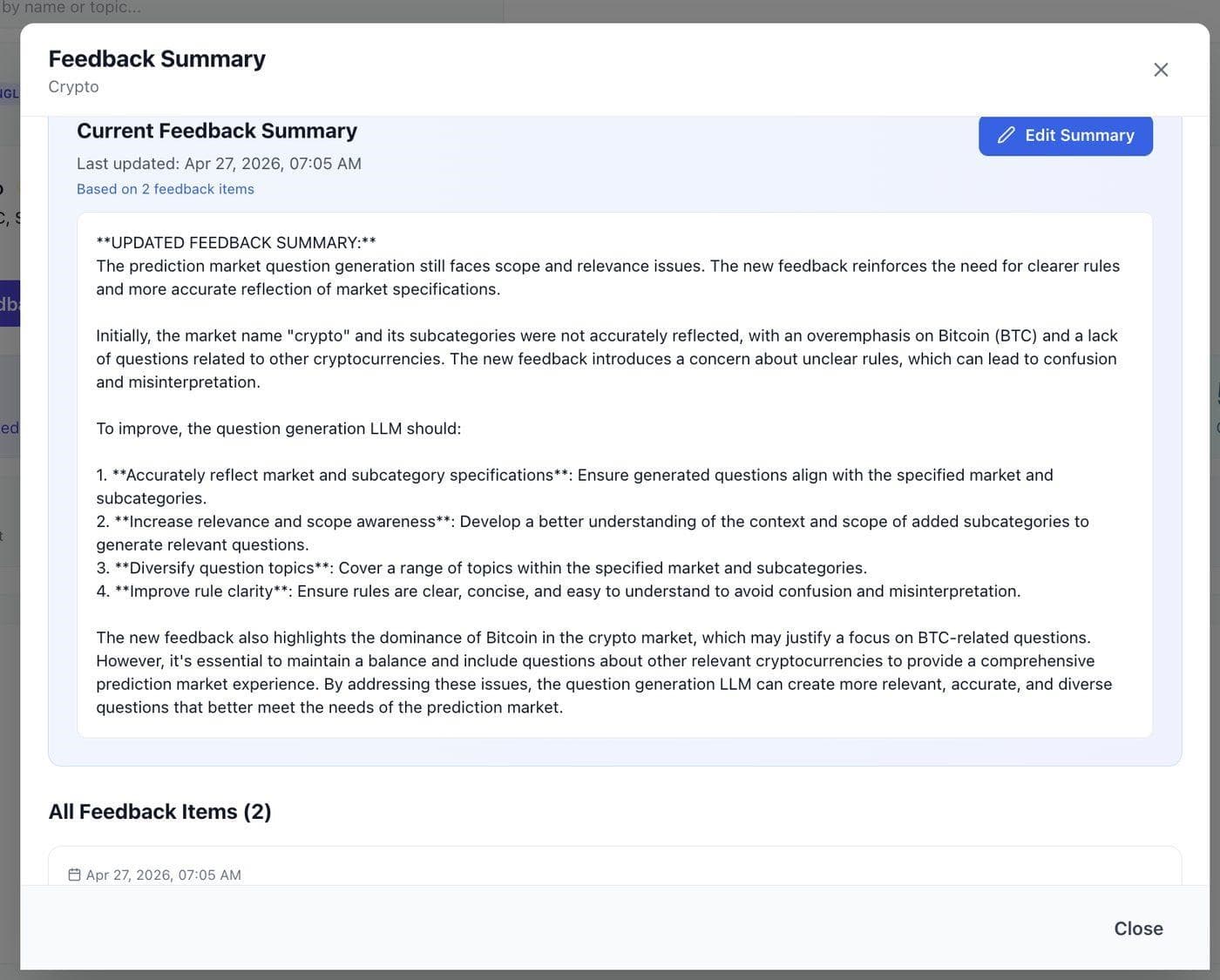
*Feedback summary: operator feedback is consolidated so future generated questions can better reflect category scope, relevance, and rule clarity.*
7. Multilingual Prediction Market
Prediction market are becoming more global. Operators may want English finance markets, Hindi sports markets, Portuguese football markets, Spanish entertainment markets or region-specific campaigns for local audiences.
Manual translation can slow down the entire content pipeline. It can also create inconsistencies because a prediction market question is not just a sentence. It may include a title, context, options, deadlines and resolution rules.
Vinfotech's generator workflow supports multilingual market generation. Operators can configure engines in the language relevant to their target audience and manage localized output inside the same creation and review process.
This is especially useful for operators entering new geographies. Instead of building separate manual content teams for every language, they can create a consistent AI-assisted workflow for regional market launches.
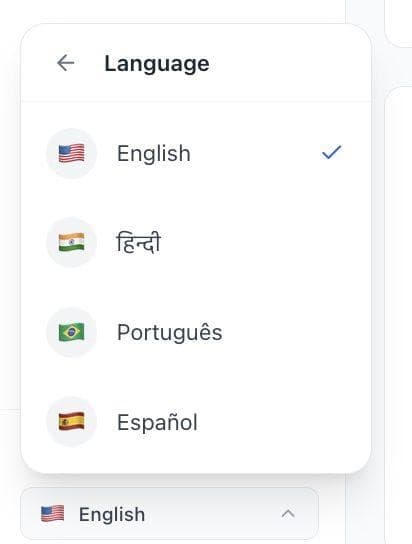
Language selector: operators can manage multilingual output for regional campaigns and localized prediction market experiences.
8. From Candidate Question to Live Market
The real value of an AI Market Generator appears when a candidate question becomes a live market.
At that point, the question is no longer just content. It becomes part of the trading experience. The wording influences user confidence. The outcome structure affects trading behavior. The deadline affects urgency. The resolution direction affects trust after settlement.
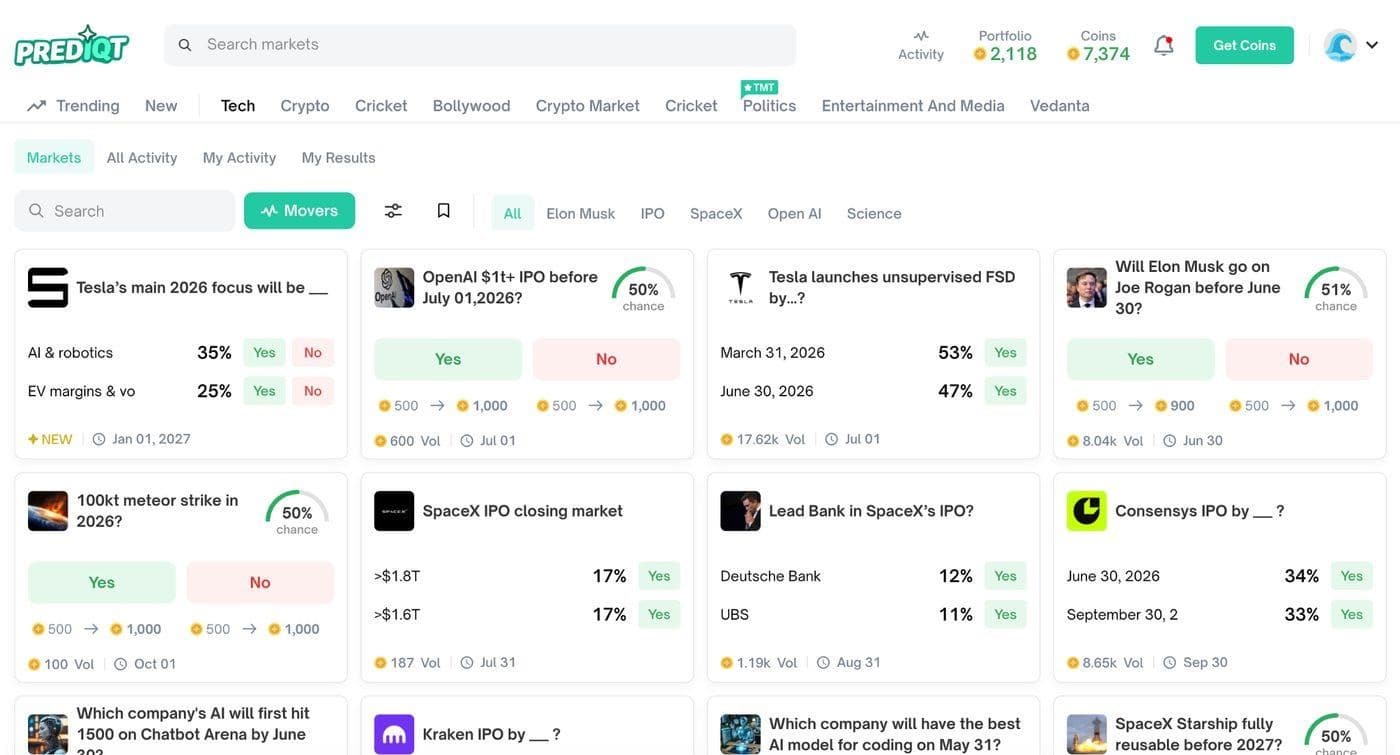
Published market experience: approved generated questions become live prediction market cards for users to discover and trade.
In Vinfotech's current product workflow, approved generated questions can be published as user-facing market cards with options, category placement, probabilities and deadlines, depending on the platform configuration.
This means the operator's work changes. Instead of writing every market manually, the team manages a smarter pipeline that prepares market opportunities at scale.
9. Why AI Market Generation Matters for Operators
AI-generated markets can change the operating model of a prediction market business.
Instead of asking, "Can our team manually create enough questions this week?" operators can ask, "Which engines should we run, which candidates should we approve and which categories should we expand next?"
That is a very different way to operate.
The main business benefits are:
- Faster market creation for active categories.
- Better coverage across sports, finance, politics, entertainment and regional topics.
- More consistent question structure.
- Reduced dependency on manual research and drafting.
- Better localization for multilingual campaigns.
- A reviewable content pipeline instead of scattered spreadsheets or chat-based approvals.
- A scalable path from topic strategy to live market publishing.
This is why AI Market Generator technology is becoming an important part of prediction market infrastructure.
10. Why Market Generation and Market Resolution Must Work Together
Creating markets is only one side of the problem. Every market that goes live must eventually be settled.
If the question is badly framed, settlement becomes difficult. If the source plan is unclear, disputes increase. If the evidence trail is weak, operators struggle to explain the outcome.
That is why AI market generation and market resolution should be viewed together.
A good generator helps create structured, objective and resolvable questions. A good resolver helps settle those questions with evidence, review controls and audit-ready records.
To understand the settlement side of the workflow, read our blog on Prediction Market Resolution Engine: Evidence-Led, Audit-Ready Settlement.
11. What Vinfotech Offers
Vinfotech builds prediction market technology for operators who need more than a simple front-end clone. Our prediction market platform can include trading interfaces, admin dashboards, market creation workflows, AI-assisted market generation, resolver infrastructure, CLOB-based trading systems, custom integrations and enterprise controls.
Our AI Market Generator is designed for operators who want to create more markets across more categories without turning content operations into a manual bottleneck. It supports configurable generation engines, review workflows, feedback loops, multilingual output and publishing into the prediction market platform.
For operators planning serious prediction market products, this becomes a core operating capability.
Q&A: AI Market Generator for Prediction Market
1. What does Vinfotech's AI Market Generator currently do?
Vinfotech's AI Market Generator currently helps operators configure category-specific generation engines, generate candidate prediction market questions, group questions by engine and generation cycle, review the output, capture feedback and publish approved questions into the live prediction market platform.
2. Does the AI Market Generator automatically publish markets?
The product is designed with operator control. Generated questions can be reviewed before they go live. Operators can inspect, select, ignore, edit or approve questions depending on the workflow configured for their platform.
3. What information can an operator configure before generation starts?
Operators can configure details such as engine name, language, operating mode, category, subcategory, event subject and market description or instructions. These inputs guide the type of markets the system generates.
4. What problem does the AI Market Generator solve?
It solves the prediction market content bottleneck. Operators often need many timely, structured and resolvable questions across categories. Manual creation is slow and inconsistent. The generator gives them a scalable market creation workflow.
5. Does it support multilingual prediction market?
Yes. The workflow supports multilingual generation so operators can create localized market content for different regions and audiences while keeping the same review and publishing process.
6. Can the system improve from operator feedback?
Yes. Operator feedback can be captured and summarized so future generation can better reflect category scope, question clarity, editorial tone and resolution expectations.
7. Does the generator handle market settlement?
The generator focuses on market creation. Settlement is handled by the resolver side of the prediction market infrastructure. The two systems are connected conceptually because good market creation makes settlement easier.
8. Which categories can be supported?
The system can be configured for categories such as sports, finance, politics, crypto, technology, entertainment, culture and regional topics. The exact categories depend on the operator's business model, compliance needs and product scope.
9. Is this a standalone tool or part of a broader prediction market platform?
Vinfotech's AI Market Generator is part of a broader prediction market technology stack. It can be included in a custom or white-label prediction market platform depending on the operator's requirements.
10. Who should use an AI Market Generator?
It is useful for prediction market operators who want to cover many topics, create market depth, localize content, reduce manual workload and build a repeatable content operation instead of relying only on manual research and drafting.
Glossary
AI Market Generator: A system that helps generate structured prediction market questions from configured topics, categories and instructions.
Prediction Market Content Bottleneck: The operational challenge of creating enough timely, clear and resolvable markets at scale.
Generation Engine: A configured workflow focused on a category, language, subject and market style.
Candidate Question: A generated question that is ready for review but not yet published.
Review Workflow: The control layer where operators inspect, edit, ignore, approve or publish generated questions.
Feedback Loop: A process where operator feedback helps improve future generated output.
Scalable Market Creation: A repeatable operating model for creating markets across categories without depending only on manual drafting.
Ready to solve the prediction market content bottleneck?
Vinfotech can help you build AI-assisted market generation workflows, trading interfaces, admin dashboards, resolver infrastructure and end-to-end prediction market technology for your business.
Contact Vinfotech to explore AI-generated markets for your prediction market platform.