For years, brokers have competed using the same levers: tighter spreads, more instruments, faster onboarding, better charting tools, cleaner apps, and stronger educational resources. While these factors still matter, they are no longer enough on their own.
The next major growth opportunity is not just another asset class, but an entirely different trading approach—prediction market, often offered as event contracts or forecast contracts. This shift is no longer just theoretical. Robinhood has reported prediction market as one of its fastest-growing product categories, with over 12 billion event contracts traded in 2025. Similarly, Interactive Brokers has been expanding its forecast contracts across multiple regions, including Canada and Europe, and extending trading hours.
This trend is important because when brokers adopt a new category, it is typically to solve a core business challenge—and this is where a prediction market platform for brokers becomes highly relevant.
Prediction market address multiple challenges at once. They enable brokers to attract a wider and more diverse audience, unlock new revenue streams, increase user engagement and session frequency, and deliver a simpler, more intuitive trading experience. This experience aligns well with a generation accustomed to mobile-first platforms, social media, real-time updates, and opinion-driven interactions. Today, Robinhood actively integrates prediction market within its app, while Interactive Brokers offers forecast contracts through its Forecast Trader ecosystem for eligible users, further reinforcing the growing importance of a prediction market platform for brokers in modern trading ecosystems.
This is why more brokers are starting to ask a serious question:
Should we have our own prediction market platform?
In many cases, the answer is yes.
First, what exactly are prediction market?
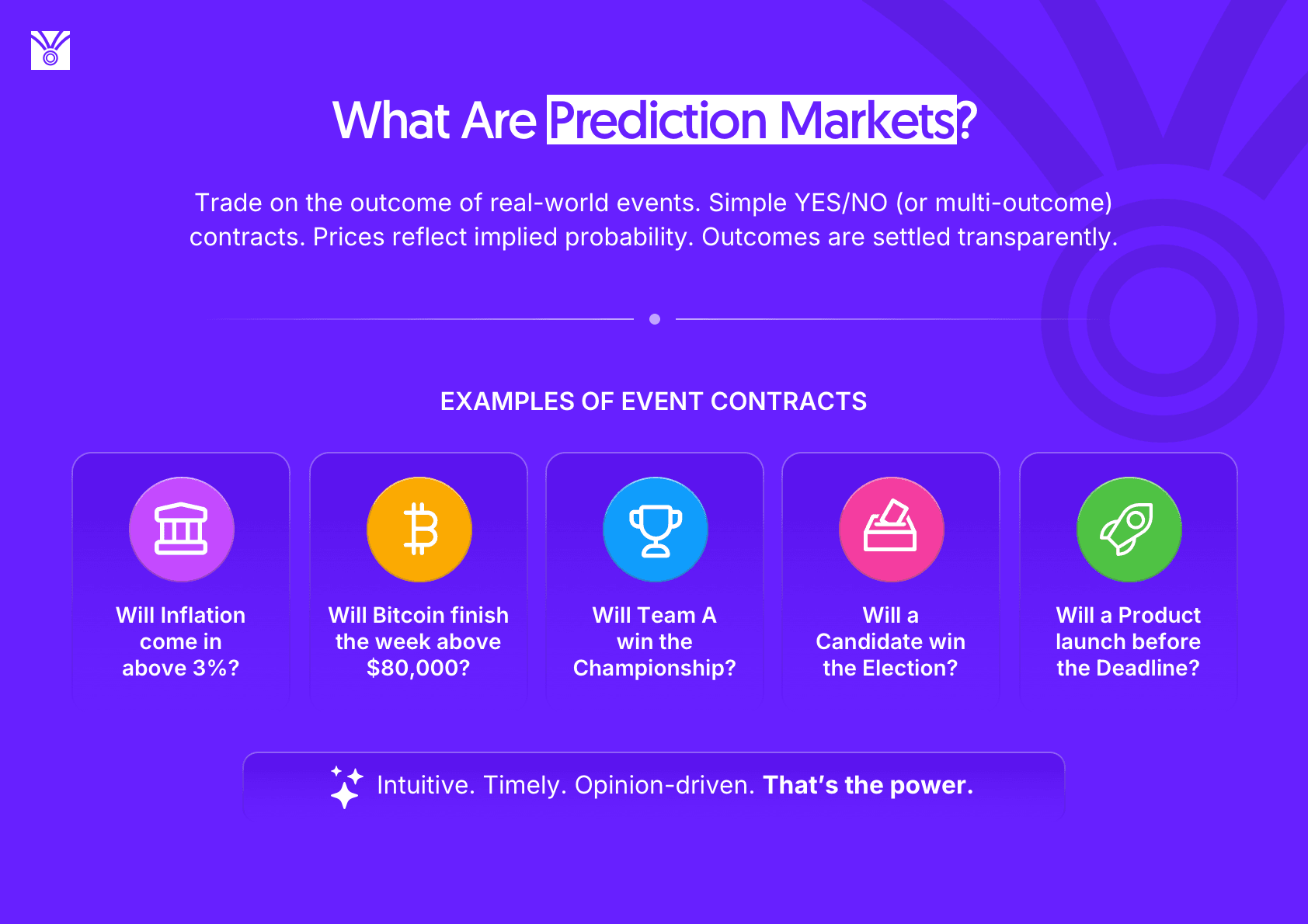
A prediction market lets users trade on the outcome of a real-world event. Instead of buying a stock, commodity, or currency, the user takes a position on a clearly defined question.
Examples include:
- Will inflation come in above a given level?
- Will Bitcoin finish the week above a threshold?
- Will a certain team win?
- Will a candidate win an election?
- Will a product launch happen before a deadline?
These contracts are commonly presented as Yes/No event contracts, where the price reflects the market’s implied probability and the contract settles based on the defined outcome. Robinhood’s educational material describes event contracts as Yes/No contracts used in prediction market, and Kalshi similarly frames its product as trading event contracts on real-world outcomes across categories like politics, economics, culture, weather, and financial markets.
To a traditional broker, that may sound like a niche product. It is not.
It is better understood as a new trading format.
Why is this resonating with traders?
Prediction market do something very important: they make trading easier to understand.
A new user may not know how to analyze an options chain, read a futures curve, or manage cross-asset exposure. But they can understand a question like: “Will the Fed cut rates this month?” or “Will the S&P 500 close above X by Friday?”
That simplicity is powerful.
It lowers the psychological barrier to entry without making the experience dull. In fact, it often makes the experience feel more immediate because the user is expressing a view on something they already care about.
For brokers, that means prediction market can sit at the intersection of trading, media, culture, and real-time opinion.
And that intersection is exactly where attention is heading.
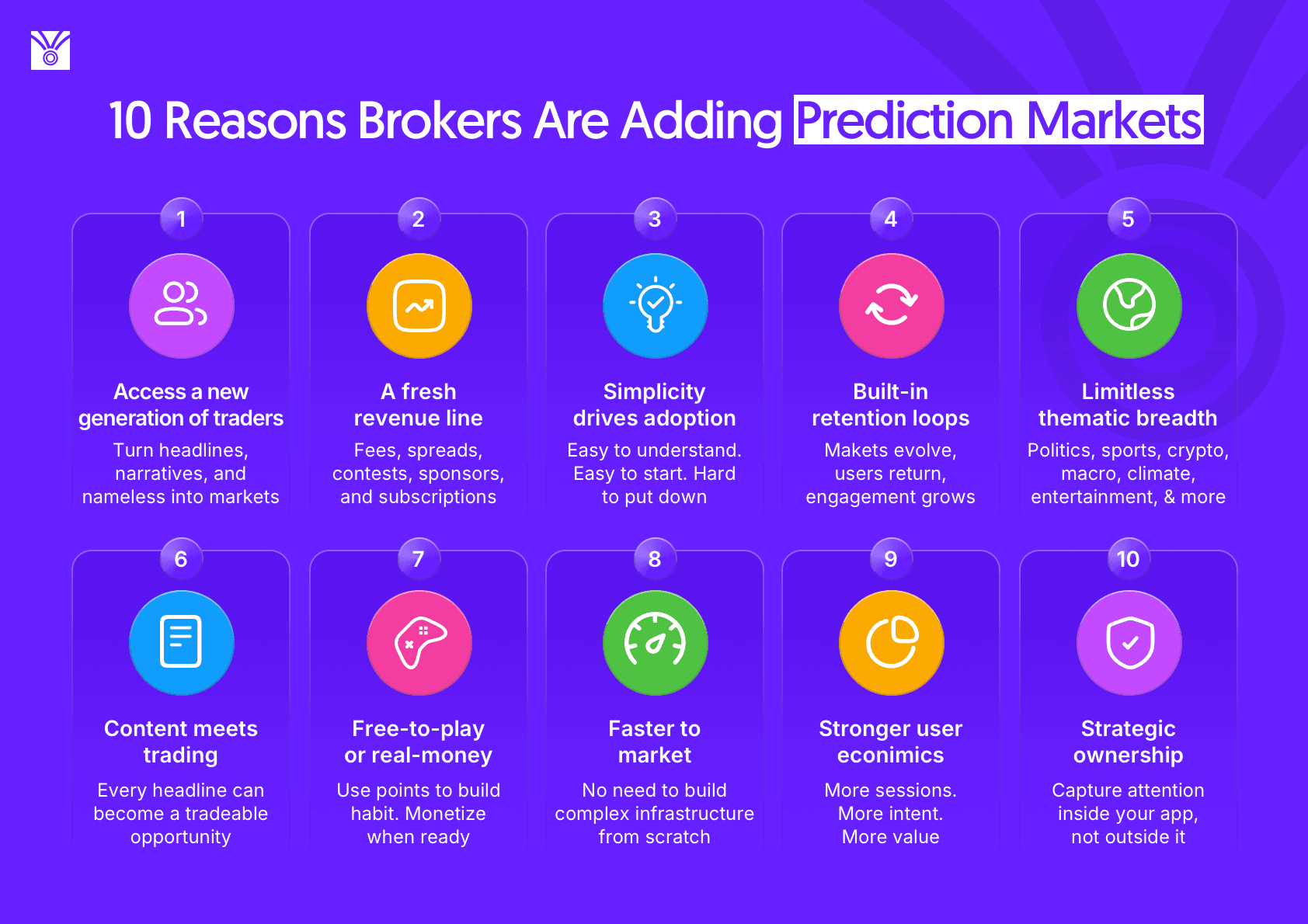
1) Brokers get access to a new generation of traders
A large portion of newer users does not begin with balance sheets, discounted cash flow models, or macro frameworks. They begin with events, narratives, headlines, creators, communities, memes, sports, elections, AI launches, and crypto sentiment.
Prediction market translate those interests into tradable questions.
That makes them unusually effective as an acquisition layer for mobile-first users who might find traditional products intimidating or slow. Robinhood’s own positioning of prediction market spans sports, politics, economics, technology, entertainment, and climate-oriented contracts, showing just how broad the thematic appeal can be.
A broker that adds prediction market is not just adding one more instrument. It is adding a more relatable front door.
2) It creates a fresh revenue line
Most broker products eventually get squeezed by competition. Commissions compress. Spreads tighten. User acquisition gets more expensive. Retention becomes harder.
Prediction market open up a new economic layer.
Depending on the model, brokers can monetize through trading fees, spreads, market-making economics, premium contest structures, sponsored events, subscriptions for advanced tools, and engagement-led upsells into adjacent products. Kalshi’s own beginner material explains the basic transaction model around event contracts, while Robinhood’s disclosures show the category has become commercially meaningful enough to warrant deeper infrastructure investment.
This is important because a good prediction market product is not just a feature. It can become a profit center.
3) The product is simpler than many traditional trading instruments
Simplicity is underrated in brokerage strategy. A simpler product does three things:
- It reduces friction in onboarding.
- It shortens time-to-first-trade.
- It improves user confidence.
Prediction market are compelling because the format is intuitive. The user sees a question, chooses a side, understands the possible outcome, and can follow the market in real time.
Robinhood’s educational content repeatedly frames prediction market through easy-to-understand Yes/No mechanics, while Interactive Brokers explains forecast contracts as clearly defined tradable questions on economic, government, and climate events.
For brokers trying to widen their funnel, that is a huge advantage.
4) Built-in retention loops are stronger than many brokers realize
Prediction market are naturally sticky.
Why? Because a good market has a narrative arc:
- It opens with a clear premise,
- It evolves with new information,
- It invites repeat checking,
- It settles with a visible outcome.
This creates a rhythm of anticipation, monitoring, reaction, and re-entry.
A trader may come back multiple times to see how odds moved, whether sentiment changed, whether new markets opened, or whether related questions are live. That creates far more frequent touchpoints than many standard brokerage experiences, especially for casual or mid-frequency users.
In other words, prediction market are not only tradable products. They are also engagement engines.
5) The category can span almost any user interest
One of the biggest advantages for brokers is thematic flexibility.
A traditional brokerage product set is usually constrained by asset classes. Prediction market are constrained only by what users care about and what can be clearly defined and resolved.
That means a broker can serve audiences interested in:
- Politics,
- Sports,
- Crypto,
- Macroeconomics,
- Financial indicators,
- Entertainment,
- Technology,
- Weather and climate,
- Cultural events.
Robinhood and Kalshi both publicly organize prediction/event contracts across many such categories, and Interactive Brokers similarly offers forecast contracts tied to economic, government, and climate-related events.
For a broker, that breadth matters because it increases total addressable engagement. Not every trader wants to trade EUR/USD or single-stock options every day.
But many will happily express a view on the Fed, the election, Bitcoin, the Oscars, a football final, or an AI launch.
6) Prediction market blend trading and content better than almost any other product
Brokers spend heavily on content, research, notifications, newsletters, webinars, explainers, and social media.
Prediction market make that entire content machine more productive. A market question itself becomes content.
A headline becomes a tradeable prompt. A macro calendar becomes a pipeline. A sports weekend becomes a sequence of markets. A big tech announcement becomes a campaign. The product turns passive attention into active participation.
This is strategically powerful because it aligns brokerage growth with the media behavior of modern users. Instead of only reacting to market prices, the broker can package current events into tradeable experiences.
That is one reason prediction market fit especially well with apps that want higher daily engagement, stronger push notification performance, and more recurring user intent.
7) They can be used for real-money trading or free-to-play engagement
This is where many brokers underestimate the opportunity.
A prediction market platform does not have to begin as a fully monetized real-money product. It can also begin as a free-to-play engagement layer.
That means a broker can launch event trading with points, play-money, reward loops, or promotional campaigns to build habit, test categories, learn user behavior, and drive platform time. Vinfotech’s own prediction market offering includes F2P modules, and its event feed system is built to support always-on question creation, rapid resolution workflows, and continuous fresh content.
This makes the category usable across multiple business goals:
- Acquisition,
- Retention,
- Education,
- Seasonal campaigns,
- Reactivation,
- Premium monetization.
For brokers, that flexibility is gold.
8) Brokers do not need to build everything from scratch anymore
A few years ago, the biggest barrier was infrastructure complexity. Today, that is much less true.
Brokers no longer need to treat prediction market as a multi-year internal R&D exercise. The category now has white-label and custom technology partners, clearer market structures, and mature implementations in the public market. Robinhood, Interactive Brokers, and CME Group all now market event/prediction-style contracts in some form, which is a strong signal that the category has moved into serious trading infrastructure.
For operators, the smarter move is often not to build from zero. It is to launch faster on proven foundations.
9) White-label prediction market platforms dramatically reduce time to market
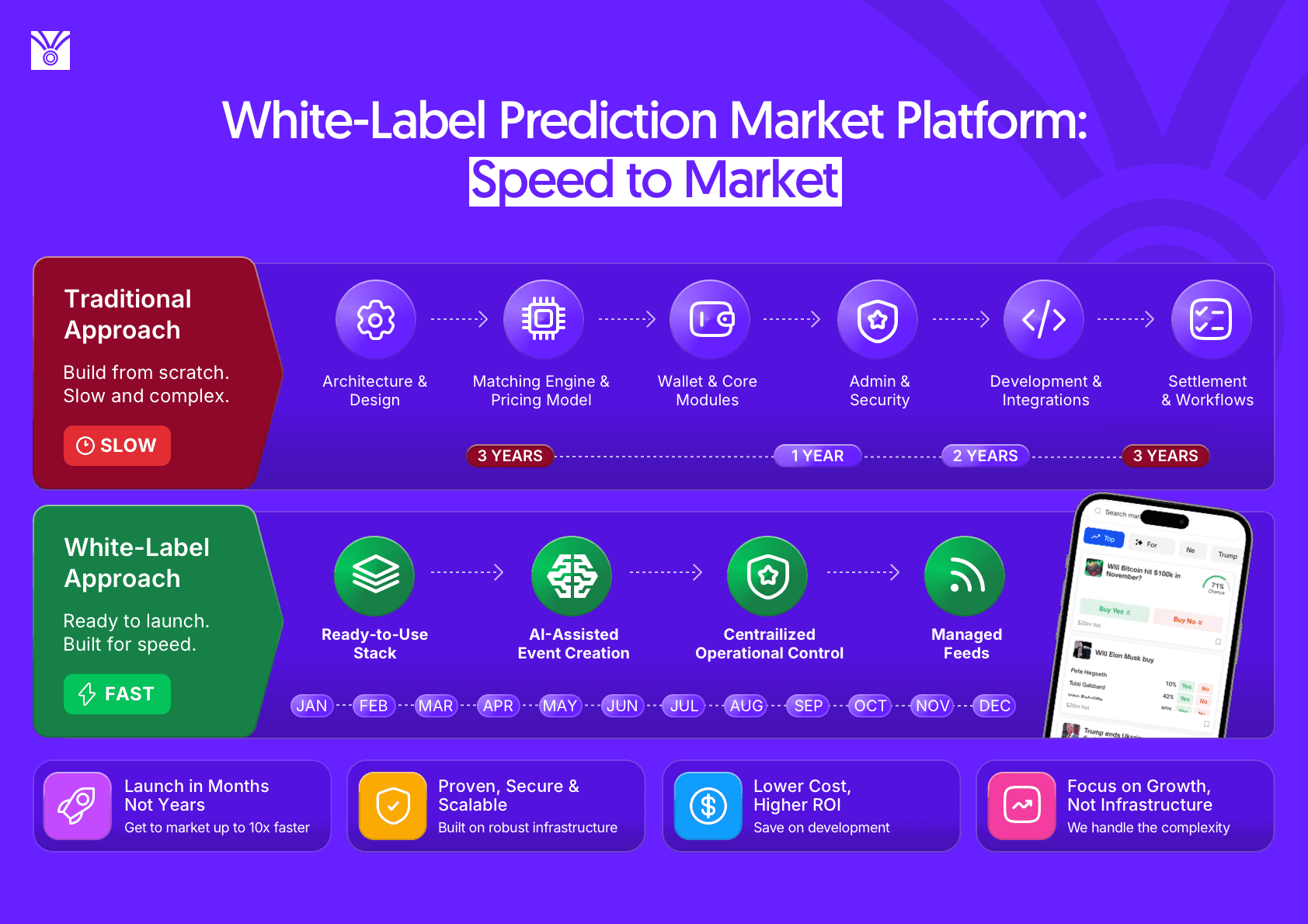
A white-label prediction market platform gives brokers speed.
Instead of spending months or years building a matching engine, pricing systems, market controls, admin workflows, resolution flows, wallet handling, APIs, real-time updates, and analytics from scratch, they can start with a working product and focus on brand, distribution, category strategy, and customer experience.
This is exactly where Vinfotech is positioned. Vinfotech describes its prediction market stack as a centralized platform with operational control over pricing, order-book matching, risk limits, market resolution, settlement, admin workflows, and flexible deployment models including white-label and custom builds.
That matters because brokers should spend their energy on growth and market fit, not reinventing core event-trading mechanics.
10) Vinfotech makes the category practical, not just aspirational
This is the part that matters for broker operators.
A lot of companies can talk about prediction market in abstract terms. Far fewer can help you actually launch one in a practical way.
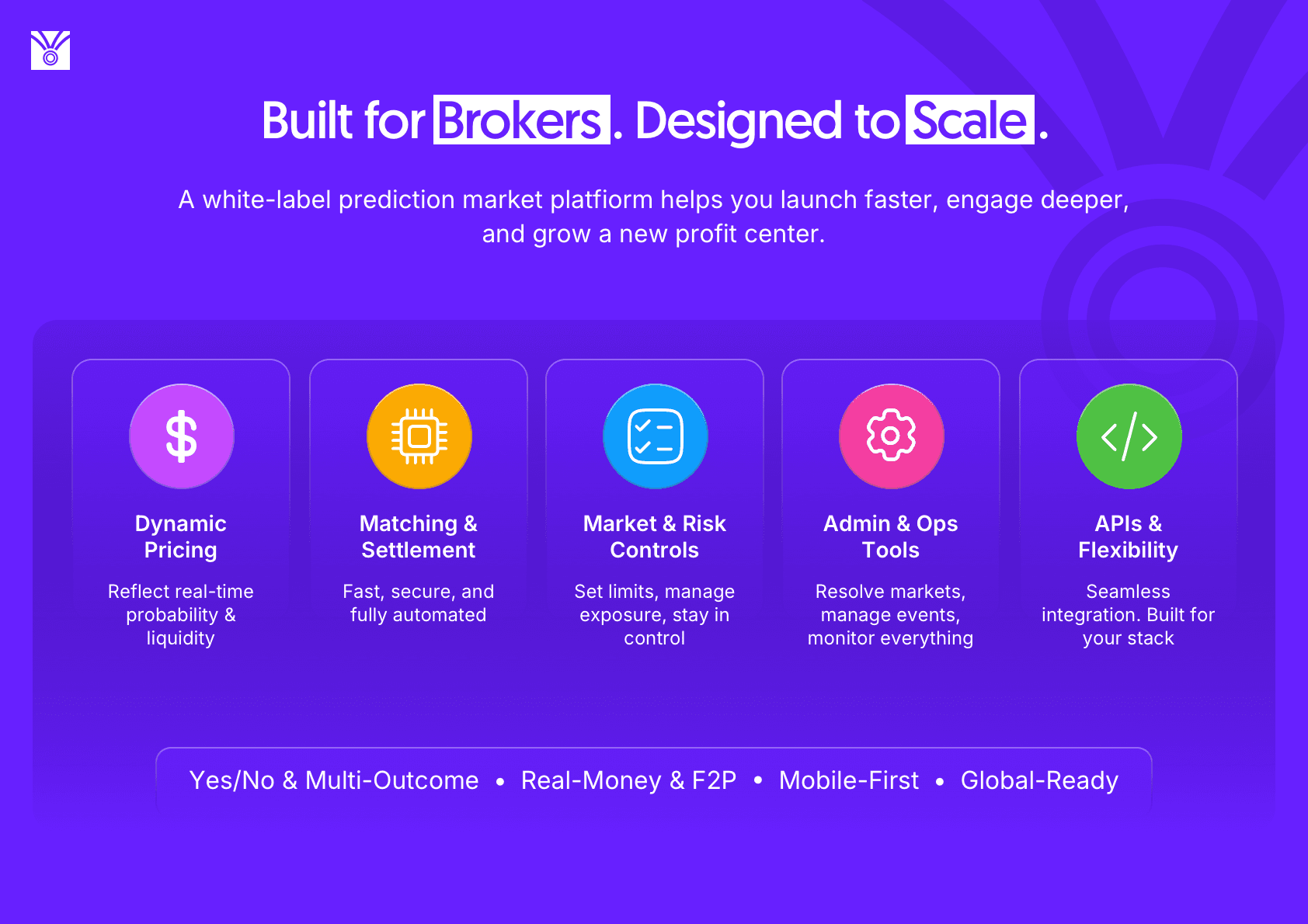
Vinfotech’s positioning is attractive for brokers because the company is not just talking about an idea. It offers a working prediction market foundation with dynamic pricing, automated matching and settlement, market resolution workflows, admin controls, and support for Yes/No as well as multi- outcome structures. It also offers managed feed capabilities with AI-assisted event creation, human- reviewed refinement, automated posting, and automated resolutions, which reduces the burden of continuously producing quality markets.
So if you are a broker asking, “How do we keep this platform full of good markets without building a large internal operations team?” that question already has a practical answer.
And if you are asking, “Can we run this as revenue-first or engagement-first?” the answer is also yes.
Vinfotech’s platform and feed positioning support both commercial models: a real-money event trading experience and a free-to-play engagement layer for user growth, habit formation, and platform stickiness.
Why this matters strategically for brokers
The best broker platforms of the next few years will not just be places where people execute trades. They will be places where people express views.
That is a broader, stronger, and more modern product philosophy.
Prediction market fit beautifully into that model because they convert curiosity into participation. They give users something to do with an opinion. They let brokers monetize attention more directly. And they create a product category that feels native to the real-time information economy.
This is not about replacing stocks, options, futures, or crypto. It is about adding a category that complements them.
A user can trade equities and still want event contracts. A user can follow crypto and still enjoy sports or politics markets. A user can be too early for options but ready for prediction market today.
That is why this category can expand both the top of the funnel and the depth of engagement within the existing user base.
The bigger opportunity: brokers can own the experience
There is another strategic reason brokers should care.
If they do not offer event trading, users will increasingly look elsewhere for it. And that means the broker loses:
- Attention,
- Session time,
- Trading intent,
- Thematic engagement,
- Cross-sell potential,
- Brand relevance with newer cohorts.
When a category begins to capture attention, owning the user relationship matters.
Brokers already have the app, the trust layer, the payment rails, the onboarding funnel, and the distribution. Prediction market can plug into that ecosystem and make it more dynamic.
That is why adding a white-label prediction market platform is not just a product decision. It is a defensive and offensive growth decision.
Final thought
Prediction market are moving from curiosity to a category. Major trading platforms now openly educate users on prediction market, event contracts, and forecast contracts. Robinhood has invested deeper after strong customer adoption, Interactive Brokers has expanded access and hours, and the language around the category is becoming more mainstream across brokerage and exchange ecosystems.
For brokers, the question is no longer whether the format is interesting.
The real question is whether you want to be early enough to shape the category inside your own platform.
If the answer is yes, the smartest path is not to build everything from scratch. It is to work with a specialist partner that already understands the mechanics, the workflows, the content layer, and the operator realities.
That is where Vinfotech comes in.
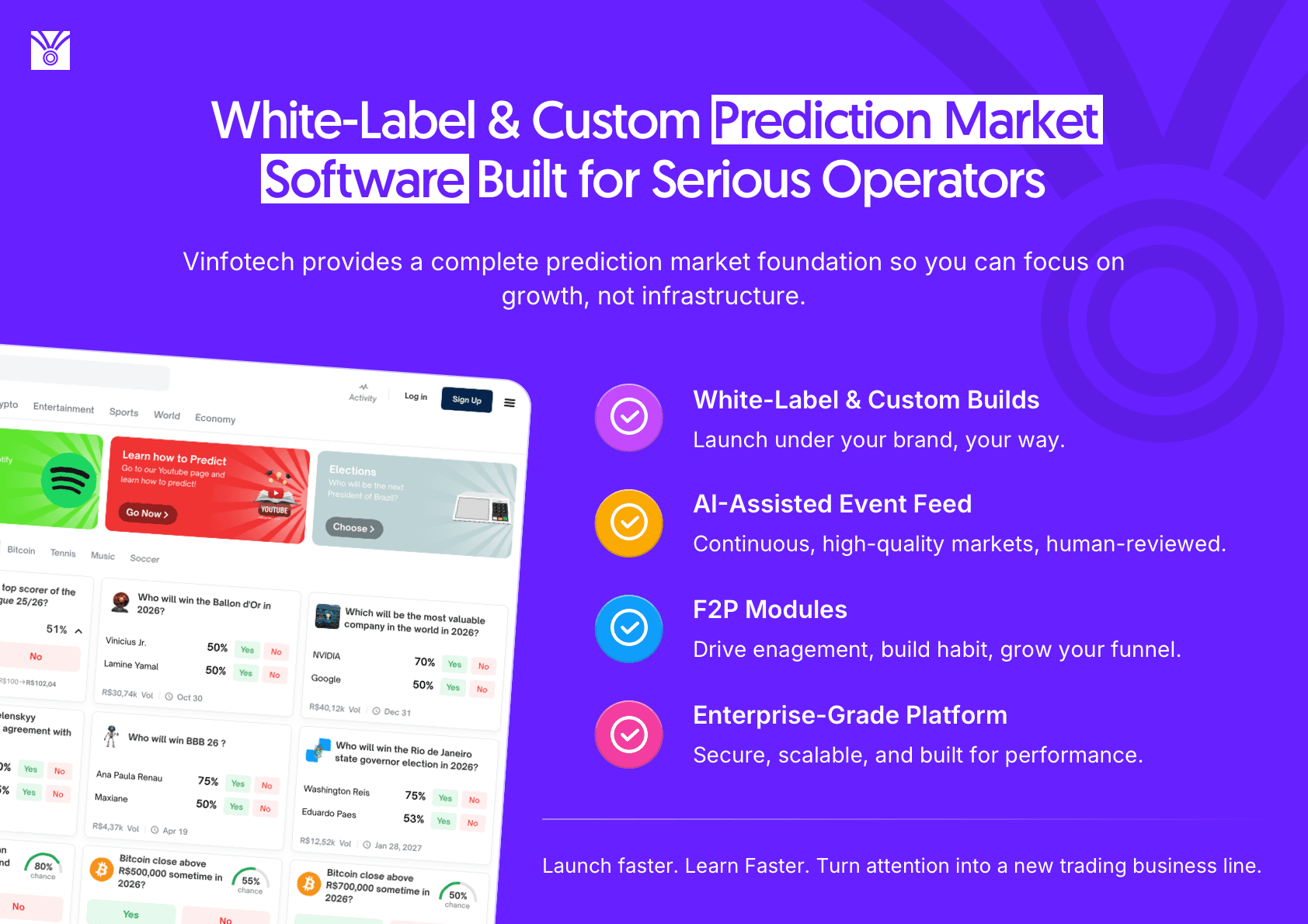
Vinfotech provides white-label and custom prediction market software built for serious operators, with dynamic pricing, matching, settlement, admin controls, market resolution workflows, F2P modules, and AI-assisted event creation and feed operations. For brokers that want to launch faster, learn faster, and turn attention into a new trading business line, that is a very strong place to start.
FAQ section
What is a prediction market platform for brokers?
A prediction market platform for brokers is a system that lets users trade on the outcome of real- world events through event contracts or forecast contracts, usually in Yes/No or multi-outcome formats. These platforms typically include market creation, pricing, trading, settlement, and admin controls.
Why are brokers adding event contracts?
Brokers are adding event contracts because they can attract new users, increase engagement, create fresh revenue opportunities, and offer a simpler trading format that complements traditional assets. Robinhood and Interactive Brokers have both expanded their prediction/forecast contract offerings, showing clear commercial interest in the category.
Are prediction market only for politics?
No. Modern prediction market span politics, sports, economics, climate, financial indicators, entertainment, technology, and more. Public category pages and educational material from Robinhood, Kalshi, and Interactive Brokers reflect this breadth.
Can brokers launch a free-to-play prediction market?
Yes. A broker can use prediction market as a free-to-play engagement product, a real-money trading product, or both. Vinfotech explicitly positions F2P modules and managed event workflows as part of its broader prediction market capability set.
Why choose a white-label prediction market platform?
A white-label platform reduces time to market and lets the broker focus on branding, distribution, and growth instead of rebuilding core event-trading mechanics from zero. Vinfotech positions its platform around exactly this model.