Settlement Is Where Prediction Market Trust Is Tested
In a prediction market, users usually see only the final result. A market settles as YES, NO, a winning option, void or no-resolution. But operators need much more than the final label.
They need to know what was checked, which sources were considered, whether the evidence was strong enough, whether a human reviewed the case and whether the final decision can be explained later.
This is where a Prediction Market Resolution Engine becomes critical.
A resolver is not just an automation script. It is the settlement infrastructure that helps operators move from manual outcome decisions to an evidence-led, reviewable and audit-ready process.
For serious operators, automated market settlement must not become a black box. It must combine AI-assisted workflows, source checks, human validation and transparent operational records.
1. The Settlement Problem in Prediction Market
Market creation gets users in. Settlement keeps trust alive.
Every market that goes live eventually creates an operational question: what happened, and can the platform prove it?
That question becomes difficult when the platform has hundreds or thousands of active markets across sports, finance, politics, crypto, entertainment and regional topics. Some outcomes are easy to verify. Some depend on official sources. Some are time-sensitive. Some require a final price snapshot. Some are ambiguous. Some may need to be voided because a defensible outcome is not possible.
Manual settlement may work in the early stage of a platform, but it becomes risky as volume grows. Decisions can be delayed, evidence can be lost, internal reasoning can remain undocumented and disputes can become harder to manage.
A Market Resolution Engine solves this by turning settlement into a managed workflow.
2. What a Prediction Market Resolution Engine Does
A resolution engine helps operators manage the journey from market question to final outcome.
At a high level, it supports:
- Registration of markets that need settlement.
- Source planning based on the type of question.
- Evidence collection from relevant sources.
- Readiness checks before outcome judgment.
- AI-assisted outcome proposals.
- Human review for sensitive or uncertain markets.
- Final settlement delivery back to the connected market platform.
- Audit-ready records of checks, evidence, actions and decisions.
This is why resolver infrastructure is a core part of modern prediction market technology. It gives operators speed, but it also gives them control.
3. From Market Question to Final Outcome
Vinfotech's current resolver workflow is built around a structured settlement lifecycle.
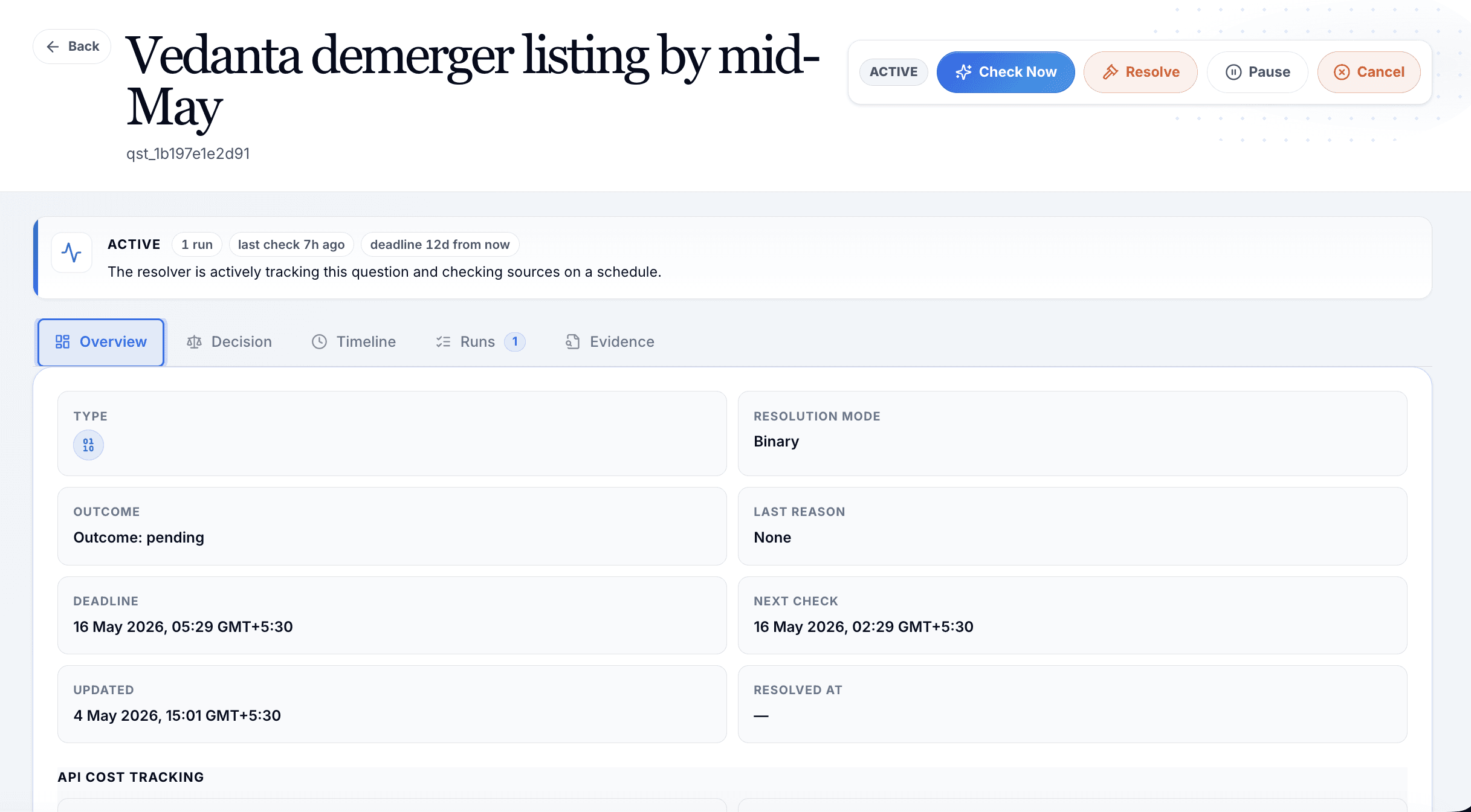
A market can move through stages such as registered, monitoring, candidate found, review required, resolved, paused, failed, cancelled or nullified. The exact workflow can vary by deployment, but the principle remains the same: every market should have a visible operational state.
This helps operators quickly answer questions such as:
- Which markets are due for settlement?
- Which markets are waiting for stronger evidence?
- Which markets need human review?
- Which markets were already resolved?
- Which markets failed and need attention?
- Which markets were paused, cancelled or nullified?
Instead of settlement happening invisibly in the background, the resolver turns it into an operational control room.
4. Source Planning: Settlement Should Not Depend on Random Search
A market should not be resolved from a random result when an official or trusted source exists.
A sports result, asset price, election update, economic release or corporate announcement may each need a different source strategy. Some outcomes should be checked against official pages. Others may rely on market data providers, trusted publications, configured sources or fallback references.
Vinfotech's resolver supports structured source planning. Operators can view or configure where the system should look for evidence, what type of answer is expected and whether the market should require review.
For public communication, the important idea is simple: the resolver helps operators separate source planning from final judgment. This protects the platform from weak or arbitrary settlement decisions.
5. Evidence-Led Settlement
Evidence-led settlement means that the final decision is supported by a record of what was checked.
In a resolver workflow, evidence may include source URLs, source names, timestamps, extracted snippets, status messages and operator-visible notes. This gives the team a record of the settlement journey before an outcome is proposed or approved.
This matters for several reasons:
- Operators can review why a result was proposed.
- Support teams can respond to user disputes more confidently.
- Internal teams can see whether a market was ready, delayed or sent for review.
- High-value or sensitive outcomes can be checked before final posting.
- The platform has a cleaner audit trail for future reference.
The point is not to expose private implementation methods. The point is to give operators a clear, explainable record of settlement activity.
Evidence and resolution journey panel
6. Readiness Checks: Knowing When Evidence Is Good Enough
Not every source update should trigger settlement.
Some markets depend on official confirmation. Some sources may update late. Some references may conflict. Some markets may have unclear wording. Some price-based outcomes may need a final snapshot at a specific time.
A resolver needs a readiness layer that helps decide whether a market is ready for judgment, should wait for more evidence, should move to review or should be nullified.
This is an important governance checkpoint. It protects operators from premature settlement and helps reduce avoidable disputes.
In practical terms, readiness checks help answer: do we have enough defensible evidence to settle this market now?
7. AI-Assisted Judgment Without a Black Box
AI can make settlement faster, but it should not make settlement mysterious.
The strongest use of AI in a resolution engine is assisted judgment backed by visible evidence. The resolver can help convert evidence into a proposed result, such as YES, NO, a selected winning option or a no-resolution recommendation.
But the operator should still be able to inspect the supporting material, review the proposed outcome and approve or hold the result.
This is the difference between automation and blind automation.
Vinfotech's resolver approach is designed around AI-assisted workflows with human control. The system can support outcome proposals, evidence summaries, review workflows and fallback handling when automation is not enough.
8. Human Validation for Sensitive Outcomes
Some markets should not be settled without human review.
This may include high-value markets, ambiguous questions, sensitive categories, imported markets, conflicting evidence or cases where operator policy requires approval.
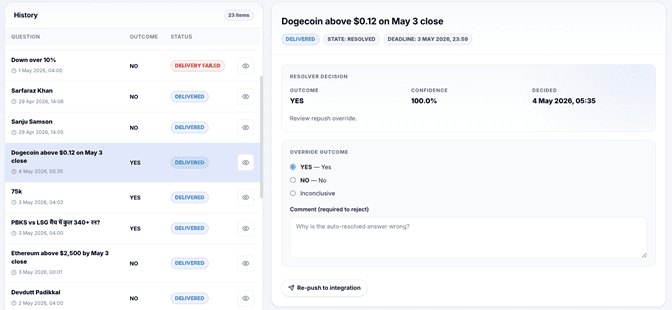
A review workflow allows authorized users to approve, hold, reject or override proposed outcomes. It also creates a decision history, which is useful for governance and dispute management.
Human validation helps operators keep accountability where it belongs. Automation reduces workload, but the operator remains in control of sensitive settlement decisions.
9. Lifecycle Monitoring: Every Market Needs a Visible State
At scale, settlement cannot be managed through memory, spreadsheets or scattered messages.
Operators need a dashboard that shows the status of each market and highlights what needs attention. Lifecycle monitoring makes settlement visible across the entire platform.
Activity and lifecycle monitoring page
Useful operational states may include:
- Registered
- Monitoring
- Candidate found
- Review required
- Resolved
- Paused
- Failed
- Cancelled
- Nullified
This visibility helps teams move faster while avoiding silent failures. It also helps management understand whether settlement operations are healthy, delayed or overloaded.
10. Cost Visibility for AI and Search-Based Resolution
Automated resolution has an operating cost.
AI models, search tools, verification passes, monitoring jobs and retries can all contribute to spend. If operators do not track these costs, they may only discover them later through provider invoices.
Vinfotech's resolver admin includes cost visibility so teams can understand usage and spend across the resolution workflow. Cost tracking can help operators review spend by time period, question, workflow stage or provider, depending on the configured implementation.
This becomes important as volume grows. A process that works for a few markets per day may become expensive at thousands of markets. Cost visibility helps operators tune automation policies without losing control.
Cost tracking overview dashboard and question-wise trends
11. Binary, Multi-Option and No-Resolution Cases
Prediction market are not always simple YES or NO questions.
Some markets have one winning option. Some may involve independent outcomes. Some may need to be voided or marked as no-resolution if a defensible settlement is not possible.
Human review page for exceptional outcomes or overriding AI outcomes
A modern Market Resolution Engine should support multiple settlement structures, including:
- Binary YES/NO outcomes.
- Single-winner multi-option markets.
- Independent outcome structures where applicable.
- Void or no-resolution cases.
- Human review for exceptional outcomes.
This flexibility matters because prediction market platforms often expand from simple markets into more complex event structures.
12. Enterprise Controls for Resolver Operations
Enterprise operators need configuration, permissions and operational controls.
Vinfotech's resolver admin can include controlled settings for provider access, users, feature visibility and branding. This may include masked provider key management, role-based access, feature toggles, review permissions, integration controls and module-level visibility, depending on deployment scope.
These controls make the resolver suitable for serious operators who need more than a basic settlement script. They need a managed operational system.
13. Why Resolution and Market Generation Should Be Connected
The best settlement process begins before the market is even published.
If a question is objective, clear and source-aware, it becomes easier to resolve. If a question is vague or lacks a source plan, settlement becomes more difficult.
That is why Vinfotech views market generation and market resolution as connected parts of prediction market infrastructure.
The AI Market Generator helps operators create structured, reviewable and resolvable market questions. The Prediction Market Resolution Engine helps operators settle those markets with evidence, AI-assisted judgment, human controls and audit-ready records.
To understand the creation side of the workflow, read our blog on AI Market Generator for Scalable Market Creation.
14. What Vinfotech Offers
Vinfotech builds prediction market platforms for operators who need flexible, reliable and scalable technology. Our platform can include trading interfaces, CLOB-based market infrastructure, admin dashboards, market creation workflows, AI Market Generator tools, Prediction Market Resolution Engine workflows, integrations and enterprise controls.
Our resolver is designed to help operators move away from manual settlement and toward evidence-led, reviewable and audit-ready resolution.
For operators planning to run prediction market at scale, this is not a minor back-office feature. It is part of the trust infrastructure of the platform.
Q&A: Prediction Market Resolution Engine
1. What does Vinfotech's Prediction Market Resolution Engine currently do?
Vinfotech's Prediction Market Resolution Engine currently helps operators manage settlement through a structured workflow that includes market registration, source planning, evidence collection, readiness checks, AI-assisted outcome proposals, human review, lifecycle monitoring, cost visibility and final settlement delivery to the connected platform.
2. Is the resolver fully automated?
The resolver supports automation, but it is designed with operator control. Depending on the market type and configuration, outcomes can be reviewed, approved, held, rejected or overridden by authorized users.
3. What is evidence-led settlement?
Evidence-led settlement means the outcome is supported by a record of checked sources, timestamps, snippets, notes and activity. This helps operators understand and explain why a market was settled, delayed, reviewed or nullified.
4. What is audit-ready resolution?
Audit-ready resolution means the system stores a traceable record of the settlement journey, including checks, evidence, status changes, review actions and final decisions. This helps with governance, dispute review and operational transparency.
5. Does the resolver support AI-assisted judgment?
Yes. The resolver can use AI-assisted workflows to propose an outcome based on available evidence. The proposal can then be reviewed by operators before final settlement where required.
6. Can operators define source strategies?
Yes. The resolver supports structured source planning so different market categories can rely on appropriate source types, such as official pages, configured references, trusted publications or data providers, depending on the implementation.
7. What market types can be supported?
The resolver can support binary YES/NO markets, single-winner multi-option markets, independent outcome structures where applicable and void or no-resolution cases. The exact configuration depends on the product scope.
8. Does the resolver track costs?
Yes. The resolver admin can include cost visibility for AI, search, monitoring and provider usage. This helps operators understand resolution costs as market volume grows.
9. Why is human review important?
Human review is important for sensitive, high-value or ambiguous markets. It keeps accountability with the operator while allowing automation to reduce routine workload.
10. How does this connect with the AI Market Generator?
The generator helps create structured and resolvable market questions. The resolver helps settle those questions with evidence and review controls. Together, they support the full lifecycle from market creation to settlement.
11. Does the resolver replace legal or compliance review?
No. The resolver is an operational and technology layer. It helps with evidence, workflow, review and auditability, but each operator must still follow its own legal, compliance and market policy requirements.
12. Who should use a Prediction Market Resolution Engine?
It is useful for operators who need faster settlement, fewer untracked manual decisions, better dispute handling, stronger governance and a more trustworthy prediction market experience.
Glossary
Prediction Market Resolution Engine: A system that helps validate and settle prediction market outcomes.
Evidence-Led Settlement: Settlement supported by checked sources and recorded evidence.
Automated Market Settlement: The use of software workflows to monitor, evaluate and settle markets with appropriate controls.
AI-Assisted Judgment: An AI-supported proposed outcome based on available evidence and configured workflows.
Readiness Check: A quality-control step that determines whether evidence is strong enough for settlement.
Review Queue: A human approval layer for sensitive, uncertain or high-value outcomes.
Nullified: A market state used when a defensible settlement is not possible.
Audit-Ready Resolution: A settlement process with stored checks, evidence, actions and decisions.
Ready to make prediction market settlement faster, clearer and more defensible?
Vinfotech can help you build a Prediction Market Resolution Engine with evidence collection, AI-assisted judgment, review workflows, cost visibility and audit-ready operational records.
Contact Vinfotech to explore resolver infrastructure for your prediction market platform.