In the world of prediction market, the "Matching Engine" is often treated as a mysterious black box. Operators know they need one, and users know their trades go through it, but the mechanical "guts" of how a trade turns into a price point is rarely understood.
For an enterprise-grade build, this understanding is the difference between a thriving, liquid marketplace and a stagnant "ghost town." This guide breaks down the core financial pillars of a matching engine and invites you to manipulate them in real-time using our Prediction Market Simulator.
1. The Engine Architecture: CLOB, AMM, or Hybrid?
The first decision in building a market is choosing the "Mode" of discovery. Each has a profound impact on how users interact with your platform. Our Prediction Market Simulator allows you to test these architectures side-by-side.
- Central Limit Order Book (CLOB): The gold standard for high-volume markets. It matches individual "Bids" (buyers) and "Asks" (sellers) directly.
- Automated Market Maker(AMM): Uses mathematical formulas to provide constant liquidity, ensuring there is always a "house" price even when no other traders are present.
- Hybrid Models: The enterprise choice. These use AMMs to "seed" liquidity while allowing a CLOB to handle organic trading.
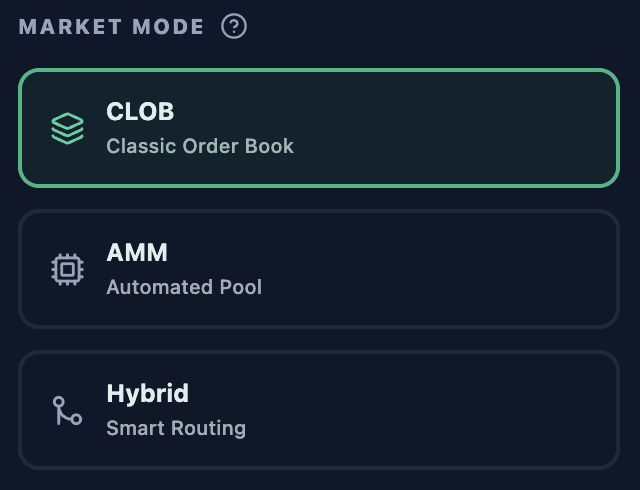
Description: This screenshot displays the simulator's configuration panel where users can toggle between different liquidity models to see how the interface and matching logic adapt.
2. Understanding Price Movements: The Discovery Module
Price isn't static; it is a living reflection of supply and demand. Our Prediction Market Simulator features a dedicated Price Discovery Module that tracks how every single buy or sell order shifts the market value.
- Real-time Adjustments: Watch how the "Last Traded Price" reacts instantly to incoming volume.
- Price Discovery Logic: See the math behind how a "neutral" market finds its equilibrium versus a market under heavy pressure.
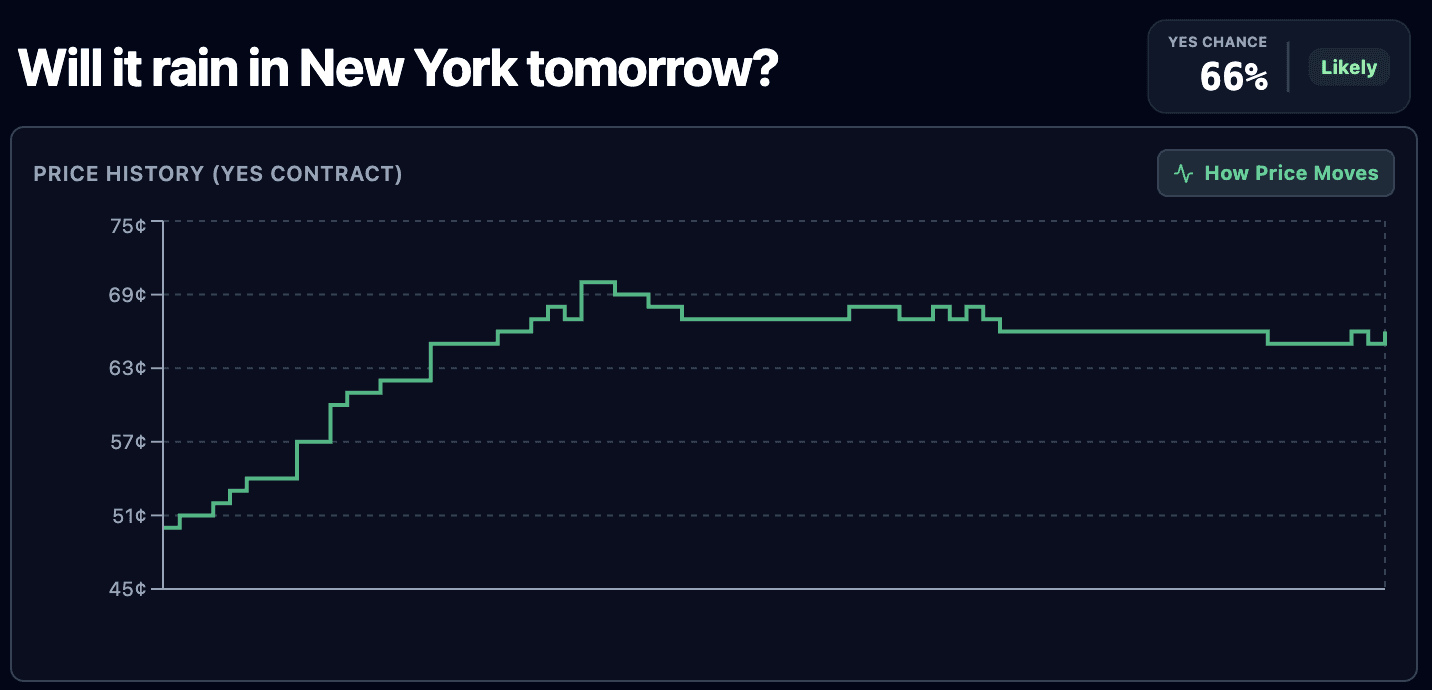
Description: This screenshot captures the Price Discovery panel, showing a line graph of price movements alongside a detailed feed of how specific trades pushed the price to its current point.
3. The Economics of the Trade: Fees, Rakes, and Spreads
A market isn't just a tech stack; it’s an economy. To make it sustainable, operators must master the "Fee Trio." By using the Prediction Market Simulator, you can see how these fees impact user behavior:
- Maker vs. Taker Fees: Incentivize liquidity by rewarding "Makers" (who add orders) and charging "Takers" (who remove them).
- The Rake: The platform's commission. Balancing the rake is critical to maintaining high trade frequency.
- The Spread: The "gap" between buyers and sellers. Our simulator shows how a wide spread indicates a "sick" market.
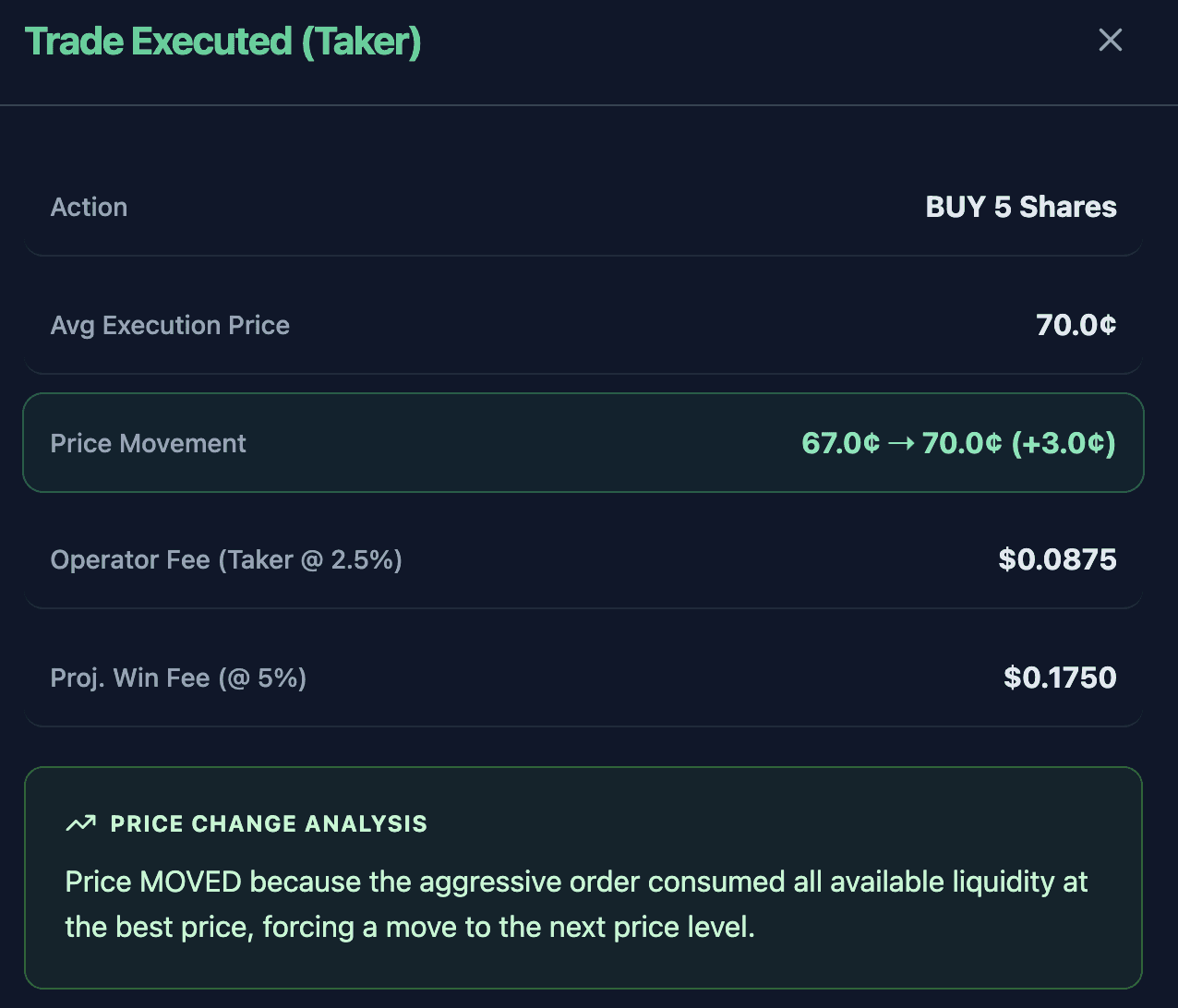
Description: This screenshot shows the detailed explanation for Maker/Taker fees and dissecting the Transaction' in the order book.
4. Safety Rails: Price Collars and Matching Tolerance
In volatile prediction market, price "flash crashes" are a real risk. Enterprise software uses "Safety Rails" to maintain integrity, all of which are configurable in our Prediction Market Simulator:
- Price Collars: These prevent trades from occurring outside a specific range (e.g., ±10%), preventing "fat-finger" errors.
- Matching Tolerance: This determines the acceptable slippage. High tolerance leads to faster matches but potentially worse prices for the user.
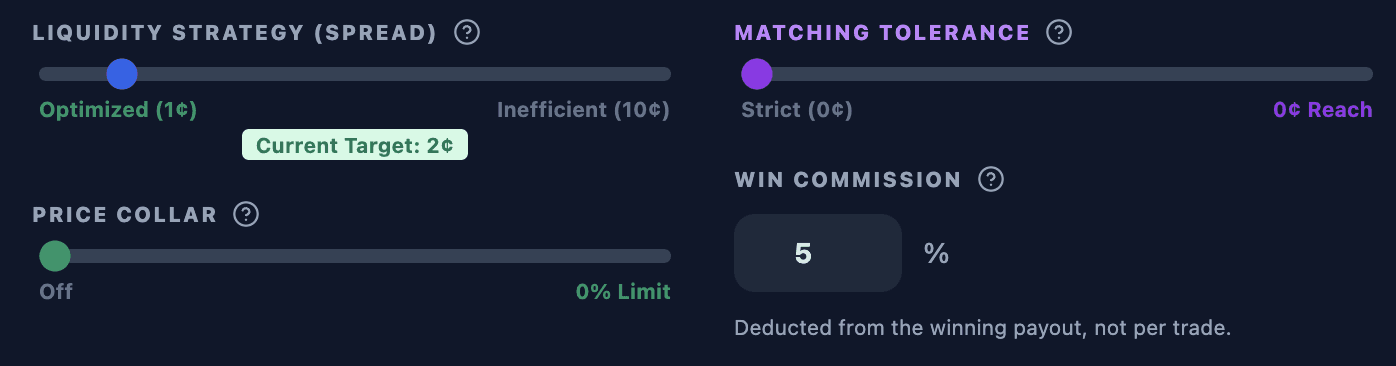
Description: This screenshot highlights the 'Guardrail' settings where operators can define the boundaries of fair trade execution.
5. Market Psychology: From Neutral to Bullish
Technology alone isn't enough; a market needs Sentiment. Our engine allows you to simulate different "Market Moods" within the Prediction Market Simulator:
- Neutral: Steady, balanced trading with low volatility.
- Bullish/Bearish: Heavy one-sided pressure that tests the depth of your Order Book and depletes liquidity.
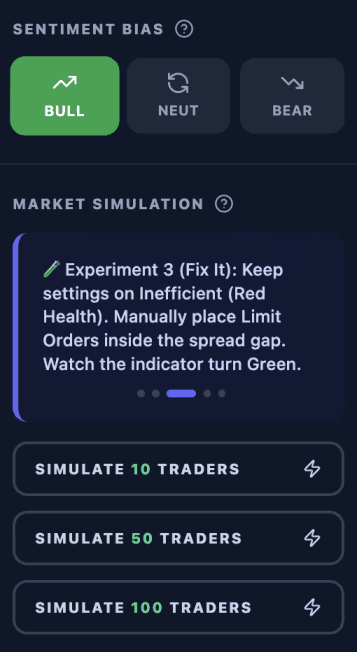
Description: This screenshot shows the 'Market Sentiment' selector being set to 'Bullish,. Here typically the transaction feed highlights how many orders are remaining 'Unmatched' due to one-sided demand.
6. Moving from Simulation to Reality
Understanding these terms is the first step. Implementing them into a robust, high-concurrency environment is the next. At Vinfotech, we don't just provide a generic matching engine. We develop:
- Custom AMM Algorithms: Tailored to your specific asset class and liquidity needs.
- Advanced Price Discovery Mechanisms: Ensuring fair execution even in low-volume environments.
- Enterprise Risk Management Tools: Native support for price collars, circuit breakers, and liquidity monitoring.
We’ve built this Prediction Market Simulator to prove that a healthy market is a strategic choice. When you're ready to build yours, we provide the enterprise architecture to make it a reality.
Glossary: Prediction Market Terms Simplified
If you've followed markets like Kalshi or Polymarket, these technical terms represent the daily experience of traders. Here is what they mean in plain English:
- Order Book: Think of this as a public "Waitlist." It’s a list of everyone who wants to buy or sell a "Yes" or "No" share at a specific price. If you want to buy a "Yes" share for $0.50 but the lowest seller is at $0.52, your request sits on the Order Book until someone agrees to your price.
- AMM (Automated Market Maker): This is the "House" trader. On Polymarket, if there are no other humans to trade with, the AMM uses an algorithm to always offer you a price. It ensures the market never gets "stuck."
- Slippage: The difference between the price you expect and the price you get. If you try to buy 1,000 shares of "Will it Rain?" on Kalshi, the first 100 might be $0.60, but the next 900 might be $0.65 because you've exhausted the cheap supply. That $0.05 jump is slippage.
- Spread: The "No-Man's Land" between the highest buyer and the lowest seller. If buyers offer $0.48 and sellers want $0.52, the spread is $0.04. A small spread (like $0.01) means a very healthy, active market.
- Price Discovery: The process of the market "deciding" what an event is worth. If a news report drops saying a candidate is leading, and the price of their "Yes" share jumps from $0.40 to $0.70, that is price discovery in action.
- Liquidity: How easy it is to enter or exit a trade. High liquidity means you can buy $10,000 worth of shares instantly without moving the price. Low liquidity means even a $100 trade might change the price significantly.
- Rake: The platform’s "convenience fee." It’s a small percentage of the trade or the profit that the platform keeps to stay in business.
- Price Collar: A "Safety Net." If a market is going crazy, a collar prevents the price from moving too far too fast (e.g., stopping trades if the price moves more than 20% in five minutes) to prevent panic or manipulation.
Ready to master the mechanics?